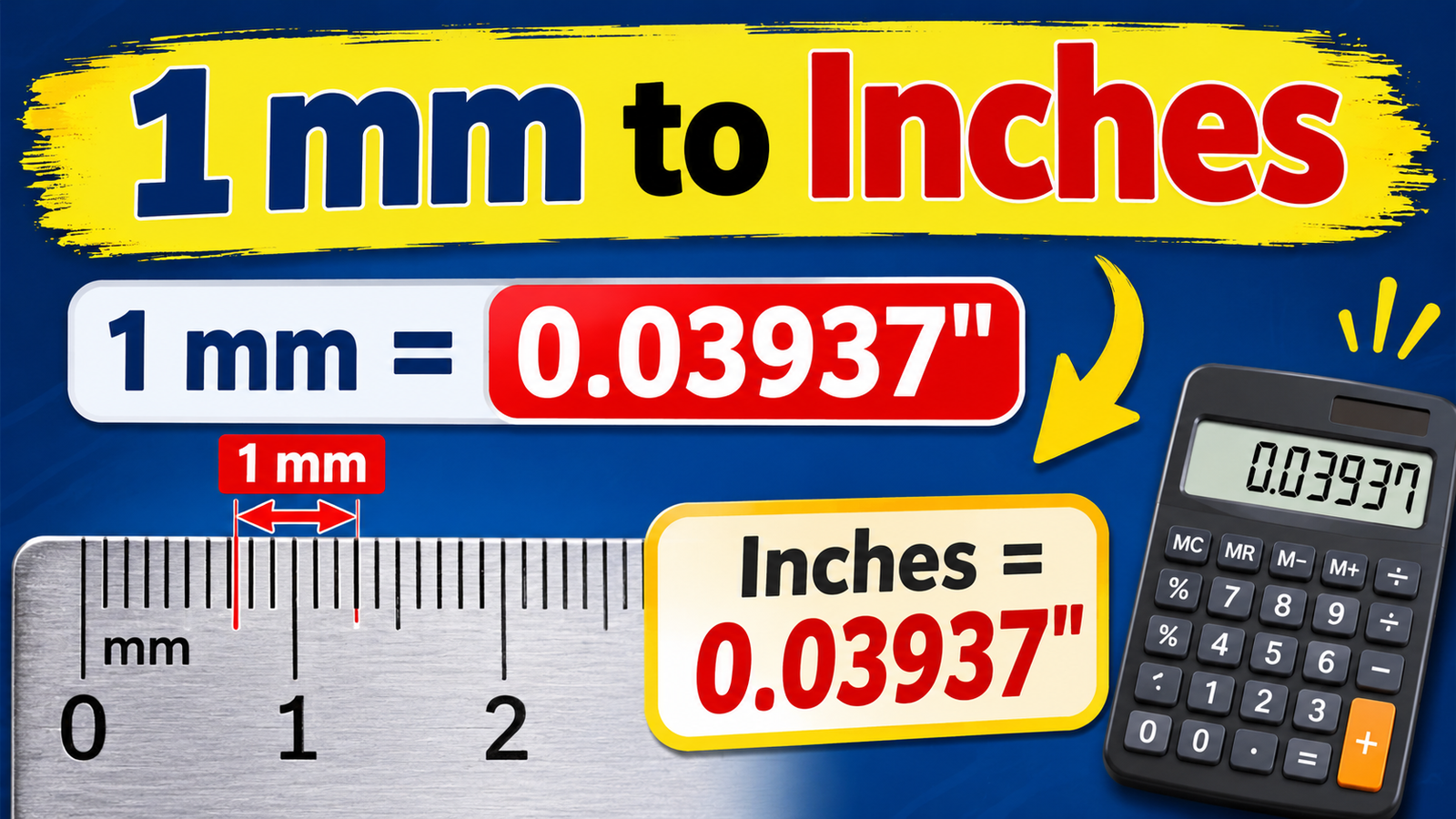
Converting one millimeter to inches is a very basic unit conversion calculation that can be done with many common applications in engineering, construction, manufacturing, do-it-yourself (DIY) projects, as well as our daily lives. One millimeter equals about.03937 inches. While both millimeters and inches are units of length, they are part of two separate measurement systems.
The millimeter is a component of the metric system, whereas the inch is often used in the United States, as well as many other contexts which utilize either the imperial or US customary measurement systems.
When you need to measure something like a small screw, a part of your cell phone, a piece of sheet metal, a ring on your finger, or any other household item, understanding how to change from mm to inches will allow you to correctly comprehend the dimensions.
This guide provides the exact conversion from one millimeter to inches, the formula used for conversion, a chart that shows millimeters and their equivalent in inches, real world examples of when to convert measurements and common errors made during measurement conversions.
How Much Is 1 mm in Inches?
The exact conversion of one millimeter is:
1 mm = 0.03937007874 inches
Rounded values: 0.03937 inches or 0.04 inches
The millimeter is an extremely small measurement of distance. There are exactly 25.4 millimeters within one inch. When you convert millimeters to inches, you simply divide the millimeter measurement by 25.4.
| Measurement | Equivalent |
| 1 millimeter | 0.03937 inches |
| 1 millimeter | 0.04 inches (rounded) |
| 1 millimeter | 0.1 centimeters |
| 1 millimeter | 0.001 meters |
| 1 millimeter | 1,000 micrometers |
| 1 millimeter | 1,000,000 nanometers |
This conversion factor was developed from the definition of the relationship between the inch and the metric system which has been established internationally. Since the Size of an inch is defined as having a measurement of exactly 25.4 mm (millimeter), the math for the conversion will be precise prior to rounding.
1 mm to Inches Conversion Formula
The formula for converting millimeters to inches is straightforward.
Formula:
Inches=Millimeters25.4
To convert 1 mm to inches, follow these steps:
- Write down the measurement in millimeters: 1 mm.
- Divide the number by 25.4.
- Calculate the result.
- Round the answer according to your required precision.
Calculation:
125.4=0.03937007874
Therefore:
\[ \boxed{1\text{ mm}=0.03937007874\text{ inches}} \]
For daily measurements, 0.03937 inches may be used. However, if you are looking for a general measurement, 0.04 inches should be fine.
Millimeters to Inches Conversion Chart
Below is a conversion table showing some of the more commonly used metric measurements in millimeters, along with the approximate English measurement in inches.
| Millimeters (mm) | Inches (in) |
| 1 mm | 0.03937 in |
| 2 mm | 0.07874 in |
| 3 mm | 0.11811 in |
| 4 mm | 0.15748 in |
| 5 mm | 0.19685 in |
| 6 mm | 0.23622 in |
| 7 mm | 0.27559 in |
| 8 mm | 0.31496 in |
| 9 mm | 0.35433 in |
| 10 mm | 0.39370 in |
| 15 mm | 0.59055 in |
| 20 mm | 0.78740 in |
| 25 mm | 0.98425 in |
| 30 mm | 1.18110 in |
| 40 mm | 1.57480 in |
| 50 mm | 1.96850 in |
| 75 mm | 2.95276 in |
| 100 mm | 3.93701 in |
You will find this chart useful when you need to make rapid conversions of measurements rather than calculating each one individually.
How Big Is 1 Millimeter?
A single millimeter is about 0.04 inches. This is less than one-tenth of an inch, which means it is an extremely small distance.
To understand its size better:
- 1 mm is one-thousandth of a meter.
- 1 mm is one-tenth of a centimeter.
- 10 millimeters make 1 centimeter.
- 25.4 millimeters make 1 inch.
- 1 mm is approximately 1/25 of an inch.
Millimeters are often used to define measurements for small items, the thickness of materials, the diameter of products or parts, as well as providing more accurate measurement of dimensions than centimeters can provide.
A millimetre is an example of a unit used to measure small objects like a single bead, a thin layer of metal, a plastic part, or a small gap.
Millimeters to Inches: Quick Conversion Examples
Here are some practical examples of converting millimeters into inches.
Example 1: Convert 2 mm to inches
225.4=0.07874
Answer: 2 mm = 0.07874 inches
Example 2: Convert 5 mm to inches
525.4=0.19685
Answer: 5 mm = 0.19685 inches
Example 3: Convert 10 mm to inches
1025.4=0.39370
Answer: 10 mm = 0.39370 inches
Example 4: Convert 20 mm to inches
2025.4=0.78740
Answer: 20 mm = 0.78740 inches
Example 5: Convert 25 mm to inches
2525.4=0.98425
Answer: 25 mm = 0.98425 inches
Example 6: Convert 100 mm to inches
10025.4=3.93701
Answer: 100 mm = 3.93701 inches
The formula can be used for both small and large measurements, as illustrated in the above examples. Simply divide the value in millimeters by 25.4.
Also Read: Kilometer to Meter Conversion | 85mm to Inches | 157cm in Feet
Millimeters vs. Inches: Understanding the Difference
Length can be measured by millimeters or inches. Each of these measurements is part of a separate measurement system.
Millimeters are a part of the metric system that is commonly used globally. Inches are part of the Imperial and U.S. Customary Measurement Systems.
| Feature | Millimeter | Inch |
| Symbol | mm | in or ″ |
| Measurement system | Metric | Imperial / US customary |
| Relationship to meter | 0.001 meter | 0.0254 meter |
| Relationship to centimeter | 0.1 cm | 2.54 cm |
| Relationship to inch | 1 mm = 0.03937 in | 1 in = 25.4 mm |
| Common usage | Engineering, science, manufacturing | US construction, tools, screens, household measurements |
The metric system utilizes powers of ten for units, so converting from millimeters to centimeters to meters can be done simply. The imperial system utilizes other methods for unit conversions (e.g., 12 inches per foot).
The ability to understand each type of unit will be helpful while you are working with products from other countries, technical specs, tools, and the size of products.
Where Is 1 mm to Inches Conversion Used?
The process of converting millimeters to inches can be beneficial across various industries and on a day-to-day basis.
1. Engineering and Manufacturing
Engineers typically design and manufacture their products, such as machine parts, metal components, and mechanical systems using metric units (mm). Specifications for machines, equipment, etc., are usually stated in imperial units (inches).
Engineers are able to compare products and work with technical drawings from different countries by converting 1 mm into 0.03937 inches.
Small changes in dimensions may make a difference as to whether components will be able to assemble correctly. Therefore, having accurate conversions is very important.
2. Construction and Home Improvement
In addition to being used in construction for imported materials, hardware, pipe, fitting and building plans, millimeters may be used in construction.
The width of a 1 mm opening is equivalent to about 0.03937 inches. Being aware of the distinction between these measurements can assist you in calculating openings, thickness, and other limited space measurements.
3. Jewelry and Accessories
A millimeter is typically used to describe how large a gemstone, bead, component in jewelry making, or a small item such as an accessory is.
A 1mm scale is especially helpful in identifying subtle aspects of a design, such as thin wires, and small decorative features.
4. Electronics and Technology
Millimeter measurements of electronic components are commonly used to define their physical characteristics. Examples of millimetric dimensional data that can be defined include the thickness of a printed circuit board, the size of connectors, the distance between components on a printed circuit board, and the tolerance limits of the manufacturing process.
Converting units of measure to inches assists those individuals using tools or specifications based on the use of inches.
5. DIY Projects
The conversion of millimeters to inches is a common task for individuals undertaking home improvement projects such as purchasing screws, measuring materials, building furniture, or using instructions provided by foreign websites.
A quick unit conversion may prevent you from buying parts that are the wrong size.
How to Convert Inches Back to Millimeters
You can also convert inches into millimeters using the reverse formula.
Formula:
Millimeters=Inches25.4
For example, if you have 0.5 inches:
0.525.4=12.7mm
Therefore, 0.5 inches equals 12.7 millimeters.
Here are some common inch-to-millimeter conversions:
| Inches | Millimeters |
| 0.01 in | 0.254 mm |
| 0.04 in | 1.016 mm |
| 0.1 in | 2.54 mm |
| 0.25 in | 6.35 mm |
| 0.5 in | 12.7 mm |
| 1 in | 25.4 mm |
| 2 in | 50.8 mm |
| 3 in | 76.2 mm |
| 4 in | 101.6 mm |
| 5 in | 127 mm |
This type of reverse conversion would be useful if the product dimensions were given in inches, however, you needed to use a metric ruler to make measurements on the product.
Important Facts and Conversion Statistics
Here are some useful mathematical facts about the millimeter-to-inch conversion:
- 1 inch = 25.4 millimeters exactly.
- 1 millimeter = 0.03937007874 inches.
- 1 centimeter = 10 millimeters.
- 1 meter = 1,000 millimeters.
- 1 meter = 39.37007874 inches.
- 1 millimeter = 1,000 micrometers.
- 1 millimeter = 0.001 meter.
The exact relationship between inches and millimeters is not an estimate but rather a precise definition. Since the decimal equivalent of one millimeter in inches has no end, most calculators and conversion tables will round off the number.
Why Is Precision Important?
Precision is critical when making a measurement that will be applied in a manufacturing process, a scientific experiment, mechanical repair work, or in a construction application.
For example, 0.03937 in. represents a round off of 1 mm. When working with projects requiring a lot of precision, you will find it much more useful to work with the complete conversion factor of 25.4 and not just some abbreviated version.
Generally speaking, for day-to-day household measurements, you will be fine with using either two or four decimal places. When working on technical projects, you should refer to the precision requirements found within your project guidelines or manufacturers’ specifications.
Conclusion
Converting 1 mm to inches is easy to do because there is a conversion factor available. One millimeter is equal to 0.03937007874 inches (approximately 0.03937 inches). To convert from millimeters to inches you must divide the measurement in millimeters by 25.4. This is a very common method for conversion in many different fields such as; engineering, construction, manufacturing, electronics, jewelry making, and do-it-yourself projects. A conversion table can be used to quickly determine the exact value of your measurements and help prevent mistakes.
FAQs About 1 mm to Inches
1. How many inches is 1 mm?
One millimeter equals exactly 0.03937007874 inches. For a simple calculation, you can round it to 0.03937 inches or 0.04 inches.
2. Is 1 mm the same as 0.04 inches?
Not exactly. One millimeter is 0.03937007874 inches. The value 0.04 inches is a rounded approximation.
3. How do I convert millimeters to inches?
Divide the millimeter measurement by 25.4. For example, 10 mm divided by 25.4 equals 0.3937 inches.
4. How many millimeters are in one inch?
One inch contains exactly 25.4 millimeters. This is the standard conversion used for converting inches into metric measurements.
5. Is 1 mm bigger than 1 inch?
No. One inch is much bigger than one millimeter. One inch equals 25.4 millimeters, meaning it is 25.4 times longer than 1 mm.
Also Read: 4cm to Inches | 71 Inches in Feet | 220 CM to Feet