
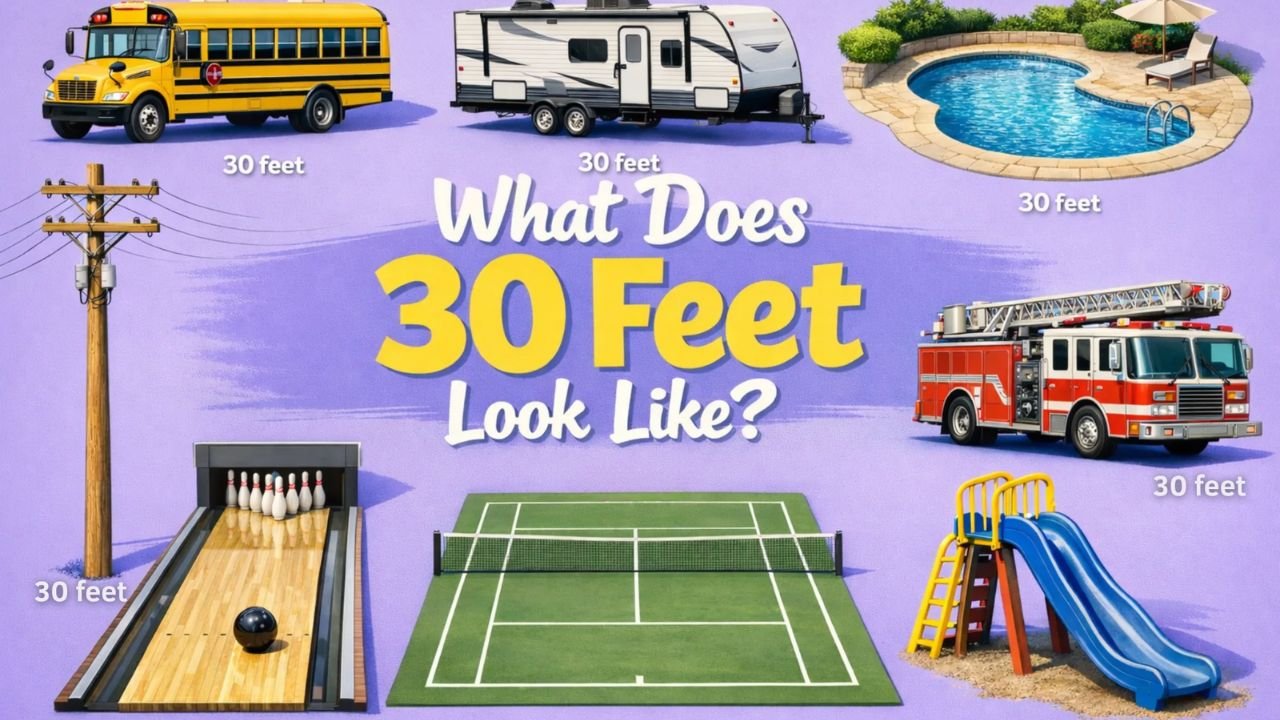
Ever wonder what 30 feet looks like? It’s a favorite measurement you might read about when buses, swimming pools, houses and open spaces are discussed. However, it’s not easy to grasp the size of a number just by viewing it.
The most straightforward way to understand a measurement is relative it with things you already are acquainted with. That could be a school bus, a large tree, or two cars parked back-to-back for instance.
In this guide, we will help readers understand How Long Is 30 Feet using 10 common examples. You will also learn how to turn feet into inches and meters, as well as a few simple methods to estimate this distance without the use of a measuring tape.
How Long Is 30 Feet?
What is 30 ft in length? Ten yards or 360 inches In metric it corresponds to approximately 9.14 meters. That’s nearly the length of a small bus, and longer than an average family car.
Here is a simple conversion table:
| Unit | Measurement |
| Feet | 30 feet |
| Inches | 360 inches |
| Yards | 10 yards |
| Meters | 9.144 meters |
| Centimeters | 914.4 cm |
| Millimeters | 9,144 mm |
To understand these numbers, remember three simple facts:
- 12 inches = 1 foot
- 3 feet = 1 yard
- 100 centimeters = 1 met
Trained on data until October 2023, think of those 30 feet as ten rulers lined up end to end, each ruler 3-feet long? They would form a straight line of 30 feet in length
10 Everyday Things That Help You Picture 30 Feet
The following examples will give you a practical idea of this length. Keep in mind that similar objects can be smaller or larger depending on model, design, and site location; consider approximating examples as guides rather than exact figures.
A School Bus
One of the most simplified ways to envision a length of approximately 30 feet is with a school bus. Some school buses are this size, but very large models can extend well past this length.
Visualize a bus parked outside of a school. It is as if one walks from its front bumper to its rear bumper. That distance should give you a sense of the 30-foot space.
For example, an additional helpful hint when considering parking spaces, roads and driveways – think of a school bus. If your driveway is approximately thirty feet long, a vehicle the size of a bus may take up most of that space.
Keep in mind school buses are not all the same size. If you need an exact measurement of a specific bus, always verify its length.
A Small Recreational Vehicle (RV)
An RV is a recreational vehicle, and RVs are vehicles that people drive for travel and camping. Certain motorhomes and RVs are as lengthy as approximately 30 feet.
Picture a tiny house on wheels, sitting by the side of a road. Inside it may have a sleep area, a kitchen, seating and space for luggage. It is a long body convenient to show how this measurement works.
A 30 foot long RV certainly requires space to park. Prior to purchasing or leasing one, individuals have to consider if it matches within their driveway, garage or camping area.
RV sizes vary widely. Manufacturers measurements will vary and while some are under 30-feet, many track longer.
A Backyard Swimming Pool
Another point of comparison could be a swimming pool. While a true ”backyard pool” isn’t likely to pack the longer 30-footer pools, some home swimming pools are closer to that length.
Picture yourself on one side of the pool and staring to the other side. Such a long pool makes it easy to see the extent of 30 feet in open space.
This is useful to compare when planning a garden, and deciding how large of an area is enough for a pool. Nonetheless, the overall space required is significantly larger than the swimming pool itself due to walking area as well as cleaning and getting in as well as out securely.
Take measurements of available space along with checking local safety mandates on the pool before selecting a design if you are considering installing a pool.
A Utility Pole
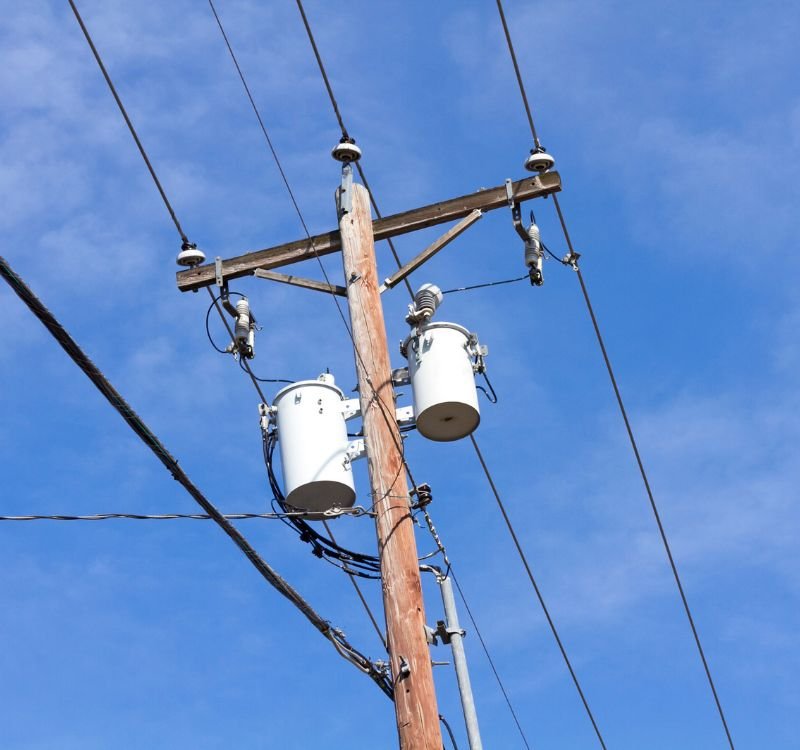
Utility poles support wires for electric power, telephone, or other communication lines above the ground. Some poles are 30 feet long and taller.
So view a poll in your region. It towers way over a man and can even grow the size of a mini building. This animal’s training is more ideal for visualizing 30 feet vertically instead of horizontally.
Note that one detail is more essential: a pole’s overall length does not always equate exactly to the height you are looking at. Some may be slotted into the ground for anchoring.
Look by no means to climb a utility pole or wrestle with electric wires. It can be used as a point of visual reference from a distance without any risk.
A Large Tree
You can envision a height of approximately 30 ft. This height is attained by some trees while others grow much higher depending upon their species and growing conditions.
Think of a big tree in the park / garden. Its trunk is raised above ground level, its branches extend outward for shade. Take the view from roots to top of tree to get a sense of how 30′ feet looks.
This is applicable – trees are common in parks, schools and neighborhoods. You do not require a measuring device to determine their height approximately against any neighboring structure or known object.
*Trees vary in height based on their species, age and growing conditions.
A Three-Story Building
Depending on each floor height and the roof, even a small three-story building is nearly 30 feet tall and could be more.
A rough way to estimate, however, is imagining each story is 10′ high. Three stories would equal 30 odd feet.
This is only a rough guide. Because of room height, high ceilings, raised foundations or a sloping roof, some buildings will measure out taller in total than others.
So this is something you can apply while searching for houses or small offices, buildings in your area. It brings home the idea that 30 feet is not all ground distance. Or well above it as well.
A Bowling Lane
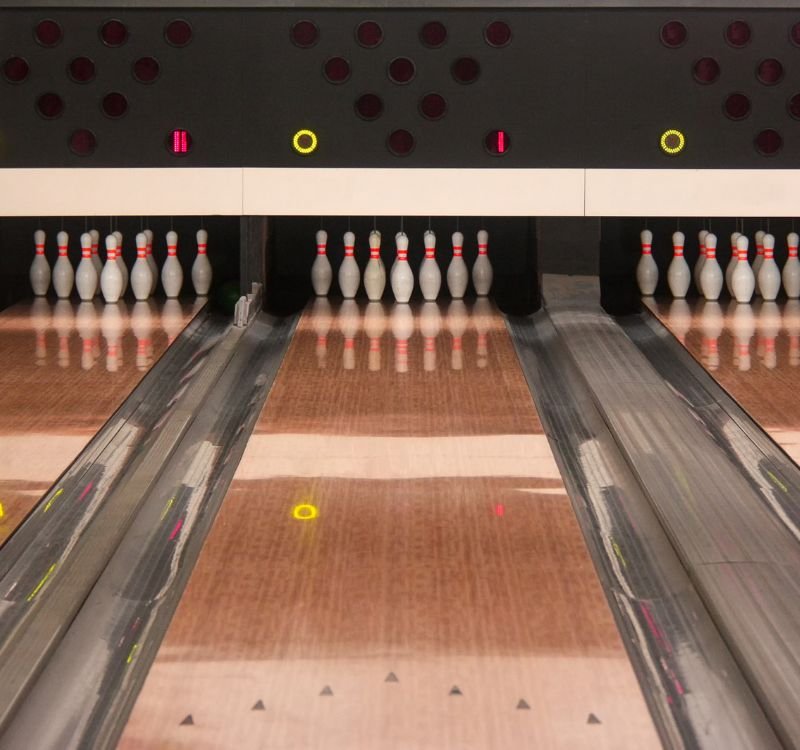
Bowling Lane: Long, slick surface that players roll bowling balls towards the pins on. From the foul line to the head pin area, a bowling lane is roughly 60 feet.
In other words, this is about the length of half a lane at 30 feet.
You are the starting line, and at your standard on Election Day. If you had moved halfway to the pins, you would likely have travelled about 30 feet.
It is a neat way of conceptualizing the measurement because most people have experienced how bowling lanes look like in games or videos. This comparison is also helpful since the lane has a defined starting point and stopping point.
Your full standard lane is 30+ feet long, so keep in mind: this example is half a lane, not an entire lane!
The Width of a Tennis Court
Tennis court is a rectangular place where participants page a ball across the net. Based on the tennis court used for singles or doubles matches, its width is determined.
From regular tennis court specs, a single court is 27 feet across while a doubles court is 36 feet wide. That 30 feet is between the two widths.
Pretend you are at the side of a tennis court, looking across. It would be 30 feet wide-just over the width of the singles court, but just under that of a doubles court.
Comparison similar for sports lovers and students learning measurements It also shows why it pays to check the precise measures, as a sports court might be the same size yet differ in detail.
A Small Yacht or Recreational Boat
Small yachts and recreational boats measure approximately 30 feet in length. These boats could be used for fishing, leisure, and short-distance trips on the water.
Think of a boat moored to a dock. Its length extends from the front, known as the bow to the back of it, called the stern. A 30-foot boat provides the most obvious example of this distance.
It’s a helpful comparison for when you are checking out boats in a marina or reading up on their sizes. It may also help some realize why you need plenty of space to dock and store boats.
Not all little boats are 30-footers Again, some might be noticeably shorter so watch out for the listed size if that is a concern.
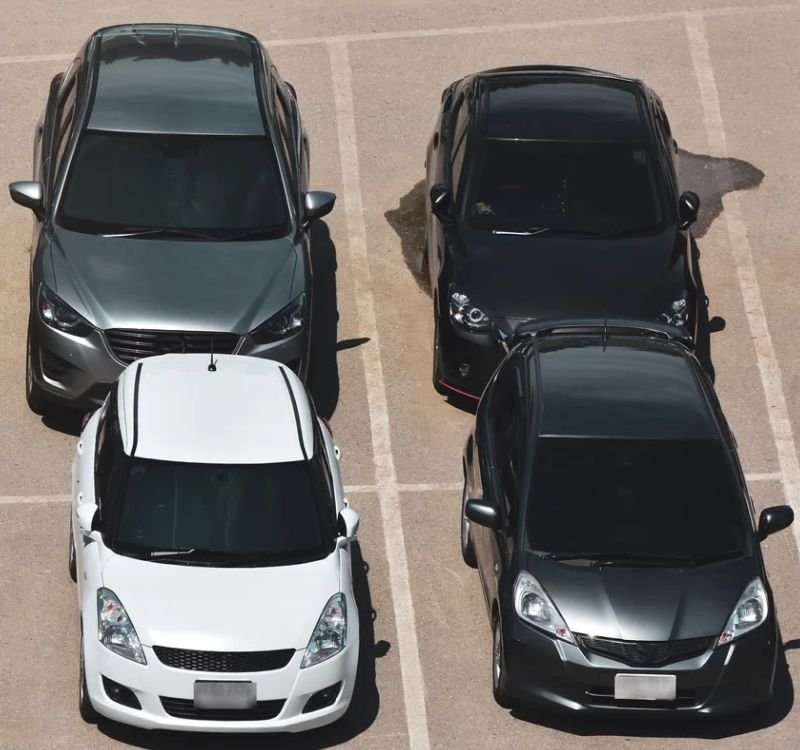
Family Cars – Two parked end to end
If two family cars are parked one behind the other they will provide you with another easy 30 foot comparison.
Most everyday cars are 12 to 16 feet long. String together two, 15-foot cars end to end and you get about 30 feet in length.
Imagine one car parked nose to butt in such a way that the ends of both cars are touching the outline of your imaginary line. They all cover nearly 30 feet together.
This can help when estimating the driveway space, parking areas, or the length of a garage. But cars vary in size and since there is spacing between parked vehicles, the distance will add up.
Avoid setting up a parking or construction plan based on this approximation – use a measuring tape instead!
How to Measure 30 Feet Without Confusion
You don’t need to understand advanced maths in order to calculate a length. Here are three easy methods:
Method 1: Count yards. Because 1 yd =3 ft, thus 10 yd=30 ft. This is an easy way to measure the distance if you have a measuring tape or are stuck out into yards.
Method 2: Measuring Tape. Put the seam tape at the beginning point and stretch it all to 30 feet. Measure in chunks and sum the lengths if your tape is shorter.
Method 3: Use familiar objects. Compare the distance with a bus, two cars, or another object whose dimensions you can recall. This will give you a ballpark, but this is no substitute for an actual measurement.
If measuring up a drive, fence or area where a building will go, keep the tape straight and on line.
Conclusion
Comparing objects you see on a daily basis makes understanding How Long is 30 Feet MUCH clearer. To help put that distance in perspective: a school bus, backyard pool, large tree; or a bowling lane or two parked-end to-end cars.
The first and foremost simple conversions to remember are 30 feet = 360 inches(10 yards),~9.14 meters. These numbers are useful to know when you consider the space for a parking, garden or home construction project.
Rough estimates and learning – everyday comparisons are excellent. If this size is critical for you then please always measure the actual area or refer to the product specifications available from its manufacturer level.
Frequently Asked Questions
How many inches are in 30 feet?
There are 360 inches in 30 feet because each foot contains 12 inches. Multiply 30 by 12 to get 360.
How many meters are in 30 feet?
Thirty feet equals 9.144 meters. For everyday use, you can round this to about 9.14 meters.
Is 30 feet longer than a car?
Yes. Most ordinary cars are around 12 to 16 feet long, so 30 feet is roughly the length of two cars parked end to end.
How long is 30 feet compared with a school bus?
Some school buses are around 30 feet long, making them a helpful comparison. However, bus lengths vary by model.
Can I estimate 30 feet by walking?
You can make a rough estimate by walking across the space, but the number of steps depends on your stride. For a precise measurement, use a measuring tape.




2 thoughts on “How Long Is 30 Feet? 10 Everyday Examples to Understand the Size”