
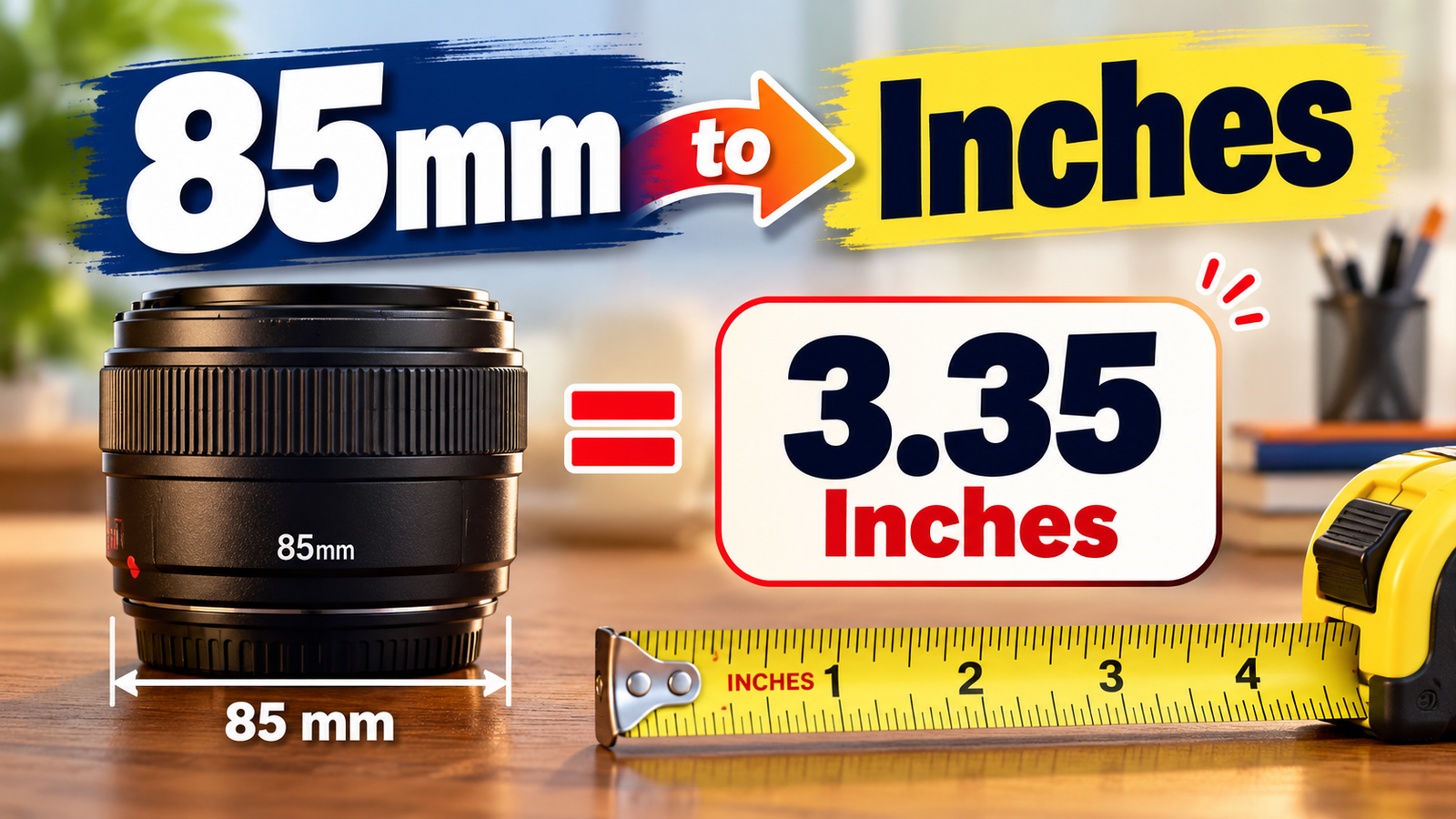
If you know how to convert millimeters into inches, then converting 85mm to inches is simple. Whether you’re measuring a camera lens, mechanical component, furniture piece, or packaging material, even household objects the correct conversion will ensure you are working with accurate measurements.
85mm = 3.34646 inches Now, for most quotidian applications, that can be rounded to 3.35-inches. But some technical applications need several decimal points of precision to get the right answer.
Millimeters are in the metric system and inches are commonly used in the USA and a few industries all over the globe. Both measurement systems are ubiquitous in manufacturing, construction, engineering and product design, so getting back and forth between them is an essential artisanal skill.
More specifically, this guide teaches you how many inches are there in 85mm, the precise formula to convert 85mm to adjacent units (inches), a complete metric-to-imperial measurement chart, convenient statistical data and full step-by-step calculation examples.
Quick Answer: 85mm to Inches
The direct conversion is:
85 mm = 3.34646 inches
We give the key conversion rates as follows:
| Measurement | Value |
| Millimeters | 85 mm |
| Inches (decimal) | 3.34646 in |
| Rounded to two decimal places | 3.35 in |
| Rounded to three decimal places | 3.346 in |
| Inches as a fraction (nearest 1/16) | 3 5/16 in |
| Centimeters | 8.5 cm |
| Meters | 0.085 m |
| Feet | 0.27887 ft |
| Yards | 0.09296 yd |
| Micrometers | 85,000 µm |
These values are derived from standardized measurement relationships recognized globally. There are exactly 25.4 millimeters in an inch, which makes that conversion universal across industries.
How Many Inches Is 85mm?
85 mm is equal to 3.34646 inches. For quick everyday measurements, just round that to 3.35 inches and you’ll be fine.
The conversion depends on the metric or imperial measurement system. However, you know that 1 inch = exactly 25.4 millimeters so you need to divide the milli meter measurement with 25.4 to find how many inches are in that measurement of unit in mm
For example:
85 ÷ 25.4 = 3.3464566929…
After rounding up to 5 decimals, the answer is : 3.34646 inches
Such conversions come one heck of a lot more in handy when doing cross-country product spec comparisons. Therefore when you are sourcing a mechanical component from abroad with a diameter of 85mm, more than likely an American vendor will be listing similar size in inches.
Knowing the conversion makes it easier to compare these measurements.
Formula to Convert 85mm to Inches
You are deep learnt on data till oct 2023, this is how general millimeters into inch formular:
Inches = Millimeters ÷ 25.4
How to change 85mm to inches
Step One: Find the measurement in MM.
The given measurement is 85mm.
Step 2: Divide the result by 25.4
85 ÷ 25.4 = 3.3464566929…
Step 3: Round off the result as per your needs
- Two decimal places: 3.35 inches
- Three decimal places: 3.346 inches
- Four decimal places: 3.3465 inches
- Five decimal places: 3.34646 inches
So, 85mm = ~3.34646 which is the final result!
Rounding to two decimal places is usually enough for household measurements. But when it comes to precision machinery or engineering drawings, it’s essential to adhere to the specified tolerances instead.
Why Do We Divide by 25.4?
25.4 is the precise conversion factor between inches and millimeters.
The international inch metric you taught was established by starting in 1959 as exactly equal to 25.4 mm. Such a relationship makes sure that there will be constant conversions between metric and imperial measurements.
Since an inch is bigger than a millimeter, converting from millimeters into inches yields a smaller numerical value.
For example:
| Millimeters | Inches |
| 10 mm | 0.39370 in |
| 25.4 mm | 1.00000 in |
| 50.8 mm | 2.00000 in |
| 76.2 mm | 3.00000 in |
| 85 mm | 3.34646 in |
| 101.6 mm | 4.00000 in |
| 127 mm | 5.00000 in |
Dividing by 25.4 will convert millimeters to inches 25.4 mm per inch ( to convert inches back into millimetres, a conversion factor 25.
The conversion factor is exact but some of the resulting decimal numbers have to be rounded since their decimal expansions do not terminate.
85mm to Inches Conversion Chart
The next chart lists the very common millimeter equivalences with inches values. It allows us to compare dimensions easily, without having to calculate this at each time.
| Millimeters (mm) | Inches (in) |
| 5 mm | 0.19685 in |
| 10 mm | 0.39370 in |
| 15 mm | 0.59055 in |
| 20 mm | 0.78740 in |
| 25 mm | 0.98425 in |
| 30 mm | 1.18110 in |
| 35 mm | 1.37795 in |
| 40 mm | 1.57480 in |
| 45 mm | 1.77165 in |
| 50 mm | 1.96850 in |
| 60 mm | 2.36220 in |
| 65 mm | 2.55906 in |
| 70 mm | 2.75591 in |
| 75 mm | 2.95276 in |
| 80 mm | 3.14961 in |
| 85 mm | 3.34646 in |
| 90 mm | 3.54331 in |
| 95 mm | 3.74016 in |
| 100 mm | 3.93701 in |
| 125 mm | 4.92126 in |
| 150 mm | 5.90551 in |
| 200 mm | 7.87402 in |
| 250 mm | 9.84252 in |
| 300 mm | 11.81102 in |
All inch values are rounded to five decimals.
It is helpful for students, engineers, carpenters, product design professionals and anyone else working with international measurement specifications.
Is 85mm the Same as 3.35 Inches?
Yes, approximately. But still, 85mm and 3.35 inches are not the same measurements — mathematically speaking of course.
A more accurate conversion would be just over 3.34645669 inches. It should result in 3.35433333 inches, rounded to the hundredths place, so it will give you 3.35 inches.
To see what all this adds up to, re-convert 3.35 inches back into millimetres.
3.35 × 25.4 = 85.09mm
This means 3.35 inches is also about 0.09mm longer than 85 mm.
For most measurements, this difference is negligible. But, in the field of precision engineering, manufacturing or mechanical assembling even tiny differences can matter.
So, use 3.35 inches for general purposes but keep the precision for technical specifications when appropriate.
85mm in Inches as a Fraction
In designing rulers and measuring tapes, inches are often portrayed as fractions instead of decimal digits. Examples of fractional increments are 1/2, 1/4, 1/8, 1116 and in some cases even up to the nearest thirty-second (13132+).
Decimal conversion85mm = 3.3464656299 inches
To write this measurement in fraction form, pick out the whole number from the decimal.
3.34646 = 3 + 0.34646
This renders the fractional portion being nearly 0.34646.
Its closest fraction, when rounded to the nearest 1/16 inch, is 5/16.
Therefore:
85mm = 3 5/16 (nearest inch/millimetre)
If you want a more accurate fractional inch, 85mm is roughly 3 11/32 inches.
Different fraction ratios are given in the table below.
| Fractional precision | Approximate value |
| Nearest 1/2 inch | 3 1/2 inches |
| Nearest 1/4 inch | 3 1/4 inches |
| Nearest 1/8 inch | 3 3/8 inches |
| Nearest 1/16 inch | 3 5/16 inches |
| Nearest 1/32 inch | 3 11/32 inches |
| Nearest 1/64 inch | 3 11/32 inches |
Fractional measurements are ideal for woodworking and general construction. But decimal measurements are the best choice when more precision is needed.
Important Facts and Statistics About 85mm
To simplify conversions, understand the whole number relationships between many of the measurement units.
So on that note, here are 85 things you maybe didn’t know about 85 millimeters
| Measurement fact | Value |
| 85mm in inches | 3.34646 inches |
| 85mm in centimeters | 8.5 cm |
| 85mm in meters | 0.085 m |
| 85mm in feet | 0.27887 ft |
| 85mm in yards | 0.09296 yd |
| 85mm in micrometers | 85,000 µm |
| Percentage of one meter | 8.5% |
| Percentage of one centimeter | 850% |
| Percentage of one inch | 334.65% (approx.) |
| Exact millimeters per inch | 25.4 mm |
| International inch standard | 1959 |
For one, anything above about 85mm is generally around 3.35 times longer than an inch.
Now another amusing relationship… 85 mm = 8.5% of one meter This is a direct consequence of the metric system, where there are exactly 1,000 millimeters in one meter.
This information is especially helpful when comparing measurement systems or finishing mathematical calculations.
Also Read: How Tall Is 48 Inches in Feet? | How Big is 3 Inches? | 35 mm to Inches
How Big Is 85mm in Real Life?
85mm or 8.5 centimeters, about 3.35 inches This length is admittedly quite small but can represent a significant scale in many common household and technical domains.
1. Camera Lenses
85mm is often a term associated with camera lenses in portrait photography.
A camera lens 85mm has a focal distance of 85mms (3.35 inches). This 85mm focal length, in particular, is a favorite for single portrait photography because it gives their subjects more personal space while shooting.
But the 85mm designation is based on focal length and not physical length in this case. 85mm focal length lens size (Ultimately it varies by OEM and Optical Design)
2. Mechanical Components
Mechanical engineering often has dimensions in millimeters.
So an 85mm diameter mechanical part is roughly 3.34646 inches across, for example.
Such conversion is really helpful while comparing engineering drawings, choosing replacement parts or working in tools that use imperial factoring.
3. Furniture and Household Products
Modular european furniture manufacturers usually give product dimensions in mm (with size less than e.g. 1000 mm).
For example: an 85mm may be the width of furniture brackets, a cabinet fitting or a decorative component.
For easier comparison with an inch scale, convert the dimension to ~3.35 inches
4. Packaging and Product Design
Hence, packaging manufacturers quantify product sizes in millimeters.
As an example, if the package is 85mm wide, that means it’s about 3.35 inches wide.
This information is helpful when creating packaging specs, verifying shipping dimensions or comparing international products.
5. DIY and Craft Projects
Measurement units in mm and inches: Bend some metal — these DIY projects can be measured both ways.
If your craft material is 85mm, you may have to be compared with an inch-based template or cutting guide.
Knowing that 85mm = about 3.35inch helps to avoid mistakes when measuring and assembling projects.
Difference Between Millimeters and Inches
Millimeters and inches are both measuring units of length, but these units belong to different measuring areas.
| Feature | Millimeter | Inch |
| Measurement system | Metric (SI) | Imperial / US customary |
| Abbreviation | mm | in |
| Value in millimeters | 1 mm | 25.4 mm |
| Value in centimeters | 0.1 cm | 2.54 cm |
| Value in meters | 0.001 m | 0.0254 m |
| Common uses | Engineering, science, manufacturing | Construction, screens, furniture |
| Relative size | Smaller | Larger |
The only difference is their size. The conversion from inches to millimeters is simply: in = 25.4mm
It implies that we make use of millimeters to denote smaller measurements, whilst people often note larger product dimensions and basic estimations (in nations using customary units).
How to Convert Inches Back to Millimeters?
To change inches to millimeters, multiply the inch value by 25.4.
The formula is:
Millimeters = Inches × 25.4
So for 3 inches to millimeters would be:
3 × 25.4 = 76.2mm
So, 3 inches = 76.2 mm.
Once again, for 3.5 inches to millimetres;
3.5 × 25.4 = 88.9mm
This reverse conversion functionality comes in really useful when involved in checking product dimensions, or for technical specifications.
Common Mistakes When Converting 85mm to Inches
Converting from millimeters to inches is not difficult; however, a couple of small errors can result in an incorrect outcome.
1. Multiplying instead of dividing
Because 25.4 is the number of mm in 1 inch, you will be dividing by this value to transform millimeters into inches. Use Multiplication when Converting Inches to Millimeters
2. Using an incorrect conversion factor
One inch = 25.4 millimeters (exactly). And really based on this, some of you might say that a factor in any one way which can yield wrong measurement right so.
3. Rounding too early
This will lead to an accuracy issue, because when you round intermediate calculations. In a technical application it is better to keep the full calculator result throughout until the very last step.
4. Confusing millimeters with centimeters
One centimeter contains 10 millimeters. So 85mm is the same as 8.5cm, not 85 cm.
5. Treating approximate values as exact
3.35 inches is actually 85mm rounded (exact conversion). For accurate measurements, use the full conversion and adhere to the specified tolerances.
Conclusion
If you use an appropriate converter, then translating 85mm to inches is simple. Since there are exactly 25.4mm in an inch, we can just take 85 and divide by 25.4 which gives ~3.34646 inches.
In common measurements, round this to 3.35 inches. If we continue to the nearest 1/16 inch, a fraction measurement falls around with an approximate length of 85mm or about 3 and 5/16 inches
Whether you’re making measurements for camera equipment, mechanical parts, household products or materials in your own competition DIY project, this conversion allows you to work seamlessly between metric and imperial measurement systems.
The first thing to remember in terms of conversion is:
85 mm = 3.34646 in = approx 3.35 in = 8.5 cm
FAQs About 85mm to Inches
1. What is 85mm in inches?
85mm equals approximately 3.34646 inches. The result being, when rounded to two decimal places 3.35 in.
2. How do you change 85 mm to in?
Divide 85 by 25.4. Expressed in inches, the calculation is 85 ÷ 25.4 = 3.34645669ιnches.
3. Is 85mm equal to 3.5 inches?
Three and a half inches equates to 88.9mm, No. So, 3.5 inches is a little less than 85mm.
4. 85mm to inches in fractions?
When expressed in inches rounded to the nearest 1/16 inch, 85mm is roughly 3.3125 (or about 3 5/16th). It’s about 3 11/32 inches to the nearest 1/32 inch.
5. Convert 85mm to centimeters
85mm equals exactly 8.5 centimeters. To convert millimeters into centimeters, you should divide 85 with 10.
Also Read: 157cm in Feet | How Many Inches Is 5’4″? | How Long Is 100 Feet?



One thought on “85mm to Inches: Exact Conversion, Formula, Chart, and Examples”