
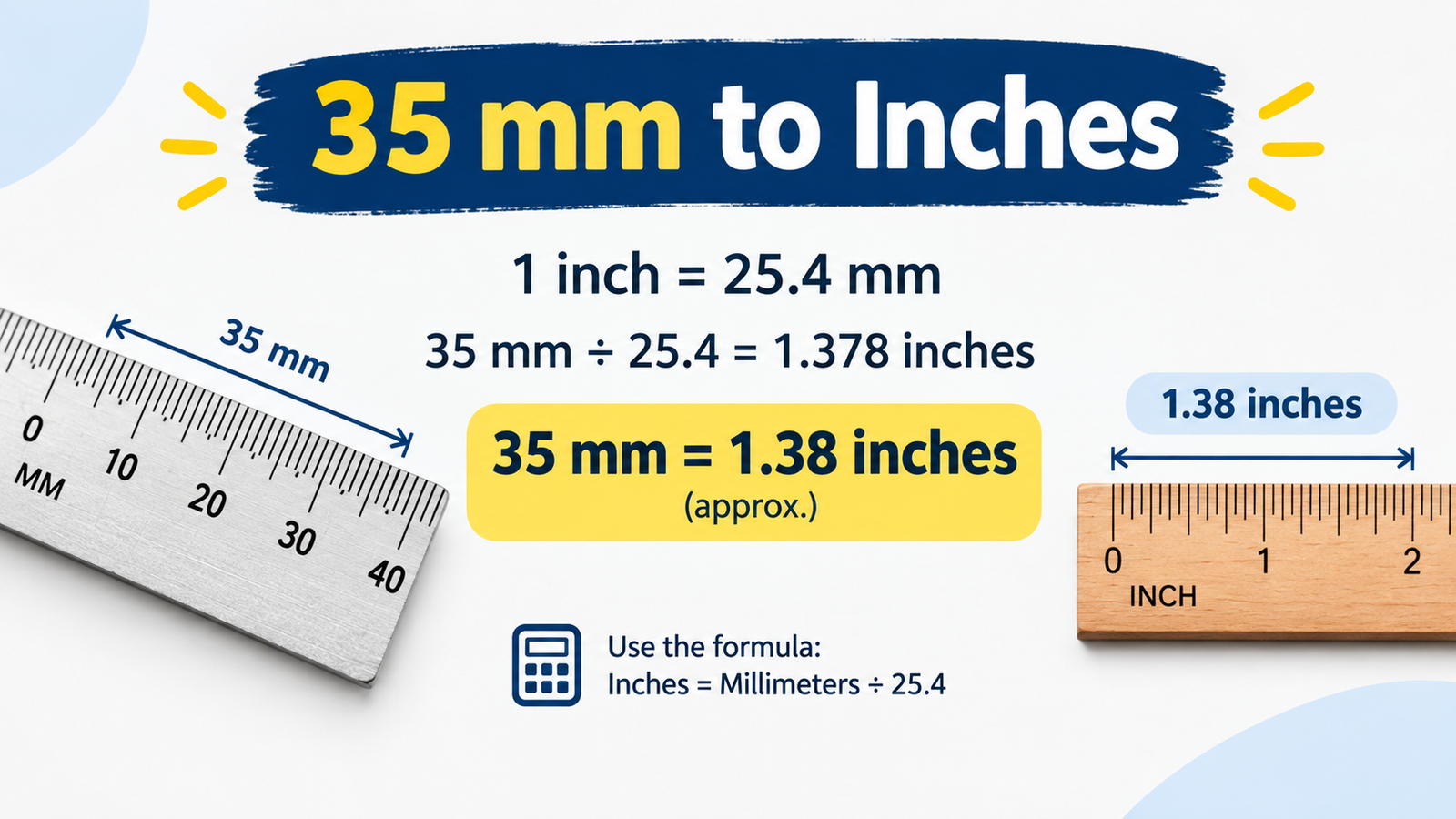
To know the right conversion for converting 35 mm to inches. Millimeters (mm): A millimeter is a unit equal to one thousandth of a meter; 35mm = about 1.378 inches, so it has its use in measuring objects, checking the dimensions of products, working with tools or converting metric measurements into the imperial system.
Millimeters are the default unit in metric-oriented countries like Canada; while other non-metric countries and most of the industry around the world commonly use inches. You might be looking to convert millimeters to inch in case of hardware purchasing, camera equipment measuring, checking screen size, reading engineering drawing or product specifications comparison.
In this guide, we will present you with how much 35 mm is in inches, the conversion formula and a millimeter to inches table, using real-life examples of measurements, including some common errors. On top of this, we will also cover millimeter and inch conversion FAQs.
What Is 35 mm in Inches?
1.38 inches = 35 millimeters, or 1.37795 inches when converted to decimal
For the conversion, you follow the internationally defined relation between inches and millimeters:
- 1 inch = 25.4 millimeters
- 1 mm equals about 0.0393701 inches
- 35 millimeters = about 1.378 inches
This is a simple spelling of the most common ways to express the result.
| Measurement | Equivalent |
| 35 mm in inches | 1.37795 inches |
| Rounded to 2 decimal places | 1.38 inches |
| Rounded to 3 decimal places | 1.378 inches |
| In centimeters | 3.5 cm |
| In meters | 0.035 m |
These conversions are based on the fact that there are exactly 25.4 millimeters per inch in standard measurements. This provides a rounded value for easy everyday use in inches.
1. How to Convert 35 mm to Inches
Convert 35 Millimeters Into Inches — You divide your millimeter measurement by 25.4
The standard formula is:
Inches=Millimeters25.4
For 35 millimeters:
Inches=3525.4
Inches=1.3779527559
Therefore, 35 mm is approximately 1.378 inches.
This formula can be used on any measurement in millimeters. Just replace 35 with the number of millimeters you are trying to convert.
If your measurement is 50 mm, then divide 50 by 25.4 = ~1.969 inch
2. Millimeter to Inches Conversion Chart
A conversion chart helps to quickly find approximate metric equivalents for common measurements in inches. And here are a few others that come in close to 35 mm, with the following table.
| Millimeters (mm) | Inches (in) |
| 5 mm | 0.1969 in |
| 10 mm | 0.3937 in |
| 15 mm | 0.5906 in |
| 20 mm | 0.7874 in |
| 25 mm | 0.9843 in |
| 30 mm | 1.1811 in |
| 35 mm | 1.3780 in |
| 40 mm | 1.5748 in |
| 45 mm | 1.7717 in |
| 50 mm | 1.9685 in |
| 60 mm | 2.3622 in |
| 75 mm | 2.9528 in |
| 100 mm | 3.9370 in |
Values are computed using the standard conversion of 25.4 mm per inch and rounded to four decimal places.
So you can refer to this chart both for home improvement projects, for some designs measurements as well for other needs that involve metric and imperial unit changing.
3. What Is 35 mm in Inches as a Fraction?
We understand some measurements better when expressed as fractions, rather than decimal numbers.
35th millimeters is equal to 1.378th inches As a fraction, this is approximately equal to 1 3/8 inches, which simplifies to 1.375 inches.
35mm and 1 3/8 inch is not equal, the difference being around 0.00295 inch. That is a tiny difference for many everyday measuring activities but may be important in precision engineering or manufacturing.
Here is a quick comparison:
| Measurement Format | Value |
| Exact metric measurement | 35 mm |
| Decimal inches | 1.37795 in |
| Nearest 1/8 inch | 1 3/8 in |
| Nearest 1/16 inch | 1 3/8 in |
| Nearest 1/32 inch | 1 3/8 in |
In this scenario, you would want to select 1 3/8 inches as that is what the nearest 1/8-inch and 1/16-inch measurements are both closest to. If the fractional value you calculate is close to how a decimal would be written, because for this one, if you really need it in millimeter detail of mechanical Part — take a decimal version and not a rounded fraction.
4. What Is 35 mm in Centimeters and Meters?
Millimeters, centimeters and meters are all within the metric system. Each of these units is linked by factors of 10 making conversions simple.
10 mm = 1 cm and 1,000 mm = 1 m.
Therefore:
- 35 mm = 3.5 centimeters
- 35 mm = 0.035 meters
- 35 mm = 0.0035 decimeters? No. To decimeters, the correct conversion is 0.35.
A summary of the most sought after conversions is given below.
| Metric Unit | Equivalent of 35 mm |
| Millimeters | 35 mm |
| Centimeters | 3.5 cm |
| Meters | 0.035 m |
| Decimeters | 0.35 dm |
For example, a small object measuring 35 mm in length is 3.5 cm long. Expressing the same measurement in centimeters may make it easier to compare with everyday objects.
5. Where Is a 35 mm Measurement Used?
35 mm – is seen in a variety of industries and common usage context. Knowing how many inches that is can help you read product specifications clearly and select the right size for your components.
Photography and Camera Equipment
You may be wondering why 35 mm should be used with photography for data. In traditional 35 mm film, the film stock is about 35 mm across and includes both perforated edges. If you picture the size of a standard 35 mm still-camera frame, its image area is typically about 36 mm by 24 mm.
Note: You are comparing film width, not lens focal length. Focal length in terms of distance is 35 mm for a 35 mm lens which corresponds to about 1.378 inches Focal length is an optical property, not the physical length of the lens.
Construction and Home Improvement
Many building materials, fittings, pipes, fasteners and other components are measured in millimeters. If it says a dimension in mm, say 35 mm, convert it to approximately 1.378 inches and you will understand what that is in imperial measurements.
But, do not just mistake a 35 mm metric component for an equivalent nominal 1“3/8 inch component. All dimensions, tolerances and standards may be different.
Manufacturing and Engineering
For example, In manufacturing metric to inch or vice versa sometimes accurate conversion is necessary. Even a fraction of an inch difference can alter the way that a component fits.
And just so you have some context, 35 mm = 1.37795 inches Engineers should keep enough decimal precision for their drawings and calculations and track tolerances that have been specified for the part.
Consumer Products and Accessories
The product sizes are sometimes reported in mm on global websites, for instance, and in inches at locations such as US shopping websites. If you compare watches, jewelry, electronic accessories, small tools and other products with their sizes stated in inches — converting all those 35 mm into inches can help.
Always investigate if the dimensions you see are length, width (or breadth), thickness or diameter.
6. How to Convert Inches Back to Millimeters
You can also reverse the conversion if you have an inch measurement and want to find its equivalent in millimeters.
The formula is:
Millimeters=Inches25.4
For example, to convert 1.378 inches to millimeters:
1.37825.4=35.0012mm
That comes out to around 35 mm. It is a tiny variation because 1.378 inches seems like the Uncle’s version of a long decimal figure.
The inverse formula is useful when reading Engineering drawings, comparing imported products, and converting dimension units between metric & imperial systems.
7. Common Mistakes When Converting 35 mm to Inches
It may be a straightforward calculation, but there are several ways the size can be measured wrong.
Using an incorrect conversion factor: 1 inch = 25.4 mm exactly If you divide by 10 or a different constant, the answer is wrong!
Rather than division, multiplication: here it is in millimeters and to convert into inches divide by 25.4. Convert Inches to Millimeters: Multiply by 25.4
Illustrative Examples rounding too early: (35 mm is pronounced about 1.3779527559 inches) 1.38 inches round is fine for many common tasks but might not cut it for more precise work.
Example: Confusing decimal inches with fractions The decimal value 1.38 inch is not equivalent to 1 and 3/8 inch (63). The latter equals 1.375 inches.
Disregarding tolerances: For simple-to-produce components that need to fit exactly, a rounded conversion might be ill-advised. However, always keep in mind the exact tolerances as given for machines, fittings or manufactured parts.
8. Quick Tips for Accurate Millimeter-to-Inch Conversion
Apply these practical tips to simplify your conversions:
- Keep in mind that 1 inch is exactly equal to 25.4mm,
- Use millimeters and divide by 25.4, to get inches.
- Inches times 25.4 equal to mm.
- When relevant, refer to 2 decimal places (generally).
- Use a higher precision with more decimal places.
- You need to measure the physical dimensions of real objects with a ruler or digital caliper.
Using a calculator or even a conversion chart reduces the chances for error when performing several measurements. Use the proper conversion factor exactly and adhere to the respective technical specifications for critical engineering applications.
Conclusion
So, using the right formula, you know how easy it can become to convert 35 mm into inches. Now thirty-five millimeters equals one point three seven seven nine four five inches, or roughly one point three eight inches in significant figures (two decimal places). Also equal to 3.5 centimeter and 0.035 meter
Useful in photography, construction, manufacturing, home improvement and product measurements. 1.38 is just about ideal for everyday comparisons. Keep more decimal places for accuracy reasons, and check what the tolerances are.
Millimeters are converted to inches via dividing by 25.4, and it is still the simplest formula you should remember. You can easily convert 35 mm and other metric values using this basic calculation.
FAQs about 35 mm to Inches
1. How many inches is 35 mm?
35 mm = 1.37795 inches which rounds to 1.38 inches
2. Is 35 mm equal to a 1 inch and 3/8 of an inch?
Not exactly. It means 35 mm is actually just one and three-eighths inch = 34.925 mm or approximately 0.075 mm smaller than the so-called true metric value of 35 mm.
3. How do we convert.35 mm inches?
Please note that you are old version data until October 2023. So for 35 mm, we can calculate as follows: 35 ÷ 25.4 = about 1.37795 inches.
4. 35 mm is equal to how many cm?
35 millimeters : 10 = 3.5 centimeters Therefore, the final conversion is for example -> 35 millimeters = 3.5 centimeters
5. How do I convert inches to millimeters?
Multiply the inch measurement by 25.4. For example, 2 inches equals 50.8 millimeters
Also Read: How Big is 5 CM? | How Much Is 2 Oz? | How Long Is 30 Feet?


2 thoughts on “35 mm to Inches: Conversion, Formula, Chart, and Practical Examples”