

When they peer at a distant road, or large airplane at an airport, or stand beside a high rise and try to fathom how many people (for example) could fit inside 100 feet. When all we see are numbers, it can be hard to visualize what those measurements represent. But the best way to visualize distance is with everyday objects.
How Long Is 100 Feet? To be clear, 100 ft is 30.48 meters = 1,200 inches = ~33.33 yards Long enough for a human to travel under his own power, but also short enough to quantify familiar landmarks like parked cars, basketball courts and shipping containers.
This measurement may come in handy when planning that garden, estimating a building’s height, checking the dimensions of your property, or just satisfying your curious nature. This guide will teach you 10 equivalent comparisons, tips and easy systems to help visualize 100 feet (no tape measure).
How Long Is 100 Feet in Everyday Measurements?
How to get a better grasp of 100 feet but comparing it with something you are familiar with. Because 1 foot = 12 inches, you can calculate by multiplying 100 × 12 to obtain one thousand two hundred inches (1,200). On your feet the only thing you can do is convert foot to meters (ft => m) by multiplying that number of feet by a 0.3048.
Here are the main conversions:
| Measurement Unit | Equivalent of 100 Feet |
| Inches | 1,200 inches |
| Yards | 33.33 yards |
| Meters | 30.48 meters |
| Centimeters | 3,048 cm |
| Millimeters | 30,480 mm |
These conversions come in handy for certain scenarios. Mile, feet and inches are commonly used in the US while meter and centimeter for other countries — including India.
As a rough mental estimate 100 ft is slightly over 30 m (for anyone who prefers m/ SI units). If you remember this simple comparison, then you do not need to memorize every conversion.
Read More
10 Real-Life Examples That Help You Picture 100 Feet
If a number is capable of connecting with something visual, the number becomes more convincing. These other examples present various options for visualizing this distance, including sport venues and transports to buildings and marine creatures.
Length : Nearly the Whole of a Basketball Court
An NBA Basketball Court is 94 feet long. In other words, 100 feet is just 6 more than the width of a football field.
Now stand at one base line and look the other way. The court is an exceptionally clear visual cue since the area to be played is clearly marked and recognizable.
You get to 100 feet by extending almost six feet past one of the baselines. When speaking in terms of a long distance for sports fans, this makes a basketball court one of the easiest examples.
Keep in mind that courts will be different sizes throughout the leagues and skill levels, so we are going to use the NBA measurement when making this comparison.
Five 20-Foot Shipping Containers
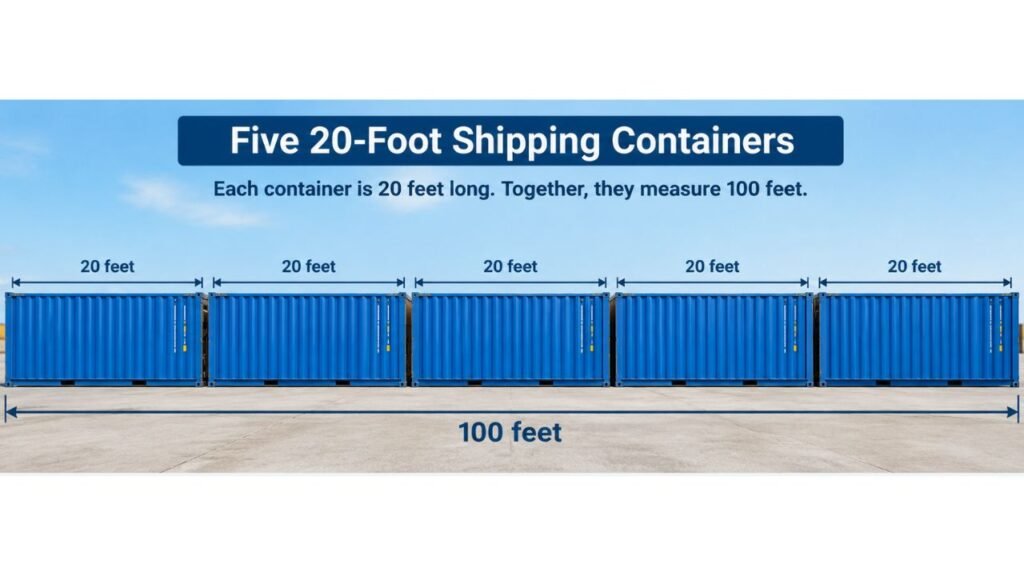
A 20-foot container, which has a nominal external length of 20 ft., Put five of these boxes end to end and nominally their total length is exactly 100 ft.
Visualize a shipping yard with multiple big metal containers lined up in a row. You can split the 500 feet into five 100-foot pieces instead of attempting to visualize one single object that is 100-feet long.
Each box is equivalent to the length of a 5th. This also makes for a great comparison to how cargo is organized in shipping and transportation.
Real external dimensions depend more on the container design, but five nominal 20-foot boxes keep things easy to visualise.
Around Seven Average-Sized Cars
Passenger cars are typically 14 to 16 feet long, although their exact length varies by make and model. So if we take 15 feet as an approximate average over a car length, seven cars parked head to tail would use approximately 105 feet.
A set of seven cars would help a bit visually – 100 feet is a little more than three times that.
You may think of a neighbourhood street where vehicles are parked along the curb. When seen at a distance, a short line of cars takes up more space than it might seem.
This is especially useful if you’re estimating driveway space, parking areas, or the length of a property boundary. Just keep in mind, the outcome is contingent on the size of each vehicle and spaces between them.
About the same length as a third of an American Football field
A traditional American football field is 100 yards between the goal lines, aka 300 feet. Thus, 100 feet equals precisely a third of the distance between those goal lines.
Now think of it as splitting the field into three, equal parts. The segments would be 100 feet long each.
This yields a helpful reference because football fields are well-marked and help identify distances. When you watch a game, you’ve likely formed a mental image of how far players run from yard line to yard line.
Note that this comparison is for the 300-foot playing field between the end zones, not including additional yards in the end zones.
Ten Stories Into The Air, More Or Less
While horizontal length is often a useful 100-foot reference, when thinking about height, a ten-story building can provide one.
As a general sense, think of one story being roughly 10-ft from the floor plate to the next. That would make ten stories closer to 100 feet.
But the floor heights of buildings are none too uniform. There are wide differences in construction types, such as residential buildings, partially buried office buildings, hotels and high entrance area structures.
Despite those differences, seeing a 10-story office building and counting its levels gives you an idea how big 100 feet of vertical distance is.
This analogy is most relevant when considering your building, structure, or height of your home near you.
Two 53-Foot Semi-Trailers
In the US a large semi-trailer may be around 53 feet (16 m) long. When two trailers are hitched together end to back, snow says they would stretch out roughly 106 feet.
Which makes them marginally longer than the span of distance you’re attempting to picture.
If you saw two huge freight trailers parked at a truck stop or a logistics yard, picture them in line with each other. You get a feel for how much real estate 100 feet takes up when you add them together.
This example is more suited to the longer trailers you see out on US highways but trailer sizes differ by country and vehicle types.
A Large Passenger Airplane

For instance, while dimensions vary greatly, you can use any passenger jet as a rough approximation of close to 100 feet in distance.
To clarify: Some versions of the Boeing 737 measure just over 100 feet in length, but they also have longer variants. Passenger aircraft can even be shorter, especially the smaller ones.
An airplane parked on an airport apron, from the nose to the tail. The length may help visualize just how much ground space is taken up by an object that’s 100 feet long.
Airplanes tend to look massive when seen next to people and airport vehicles, making this comparison particularly unforgettable. Just don’t think all passenger planes are 100 ft long, the exact length depends on the model.
Large 100 Foot Yacht

For example, a yacht that is 100 feet from the tip of its bow to the end of its stern is roughly equal to 30.48 meters in length when it comes to boats.
An implication here would be that you are training on data until September of 2023 Imagine a vessel across the marina, its bow at one end and its stern to another. It would be 100 feet long, the length you would draw a line on the dock.
A vessel of this length could potentially have multiple levels, guest rooms and crew quarters along with large facilities on board depending upon its design.
The comparison is easy, as a vessel, when measured by length. But the width and height of yachts are two different measurements and do not confuse them with its overall charter length.
A Very Large Blue Whale
Blue whale: The blue whale is the largest animal known to have ever existed and exceptionally large specimens can reach or exceed lengths of 30 metres. Since lots of adults are considerably shorter, 100 feet should be considered more of an upper-bound comparison than a standard size for each blue whale.
Now imagine the creature lying in a vast open land from its head to end of tail. To put it in perspective, a little illustration of what 100 ft can be like.
This method can be helpful in particular because very few people will have seen a blue whale in real life. It’s easier to picture the scale when you compare it with a measurement that most of us are familiar with.
Aerial Fire Truck Ladder for Extended Reach

Features Edit Some specialist aerial platform fire truck ladders can access elevations as high as 100 feet for specific emergency operations.
If the ladder is put up, this gives us a pictorial example of long-range measured vertically and not horizontally.
That said, not every fire truck is equipped with a 100-foot ladder. Extension height varies by vehicle, ladder design, operational conditions and equipment.
This example demonstrates that 100 ft is not just applicable to understanding the sizes of objects. It can also refer to machinery intended for rescue and emergency work.
How Can You Estimate 100 Feet Without a Measuring Tape?
There are a few simple techniques to estimate the distance of 100 feet. They are not substitutes for precision measuring devices, but useful for day-to-day planning.
Count your steps: A passing step of approximately 2.5 feet long will reach around 100 feet in only 40 strides. Your real stride may differ by being shorter or longer.
Football Field: Imagine one-third the distance from goal lines on an American football field.
Parked cars count: Seven cars at 15 feet each would take up about 105 feet with gaps.
Take a basketball court: an NBA regulation court is 94 feet in length, so it is just under 2 of your designated distance.
Use a known building height: A ten-story building is around 100 feet, depending on the design.
Use an approach that fits your environment. For estimating a garden, or even a driveway, it may be simplest to walk the distance. When trying to comprehend the height of a given building, it is easier to visualize it in terms of floors.
If you require precise measurements for construction, fencing, or property boundaries, then use a tape measure, laser distance meter or any other suitable measuring tool.
Conclusion
One way to make sense of How Long Is 100 Feet is to associate the measurement with familiar objects. It is 30.48m, 1,200inches and about 33.33 yards long! It is also a little longer than an NBA basketball court and roughly one-third of the length of an American football field between the goal lines.
Imagine it as five 20-foot nominal shipping containers, approximately seven average size cars and a yacht of around 100 feet from bow to back stern. Building, airplane, long ladder of the fire truck or other comparisons to compare this measurement vertically or in other objects.
Use these comparisons next time you want to ballpark a long distance. Whether you are planning a space or inquiring about measurements or simply out looking around the world, they will paint a more vivid picture of 100 feet.
FAQs
1. How many meters is 100 feet?
100 feet equals exactly 30.48 meters. For a quick estimate, you can round it to approximately 30.5 meters.
2. How many inches are in 100 feet?
There are 1,200 inches in 100 feet because each foot contains 12 inches. Multiply 100 by 12 to calculate the result.
3. How many yards is 100 feet?
100 feet equals approximately 33.33 yards. Since one yard equals 3 feet, divide 100 by 3.
4. How long does it take to walk 100 feet?
At a typical walking speed, many adults can cover 100 feet in roughly 25 to 35 seconds. Your time may differ depending on your pace, terrain, and physical condition.
5. How many steps does it take to walk 100 feet?
Using an estimated step length of 2.5 feet, it takes about 40 steps to cover 100 feet. This is only a rough estimate because stride length varies from person to person.
6. Is 100 feet longer than a basketball court?
Yes. A regulation NBA basketball court is 94 feet long, so 100 feet is 6 feet longer.
7. Is 100 feet the same as 100 meters?
No. 100 feet equals 30.48 meters, while 100 meters equals approximately 328.08 feet. A distance of 100 meters is more than three times as long as 100 feet.

One thought on “How Long Is 100 Feet? 10 Easy Real-Life Examples to Visualize the Distance”