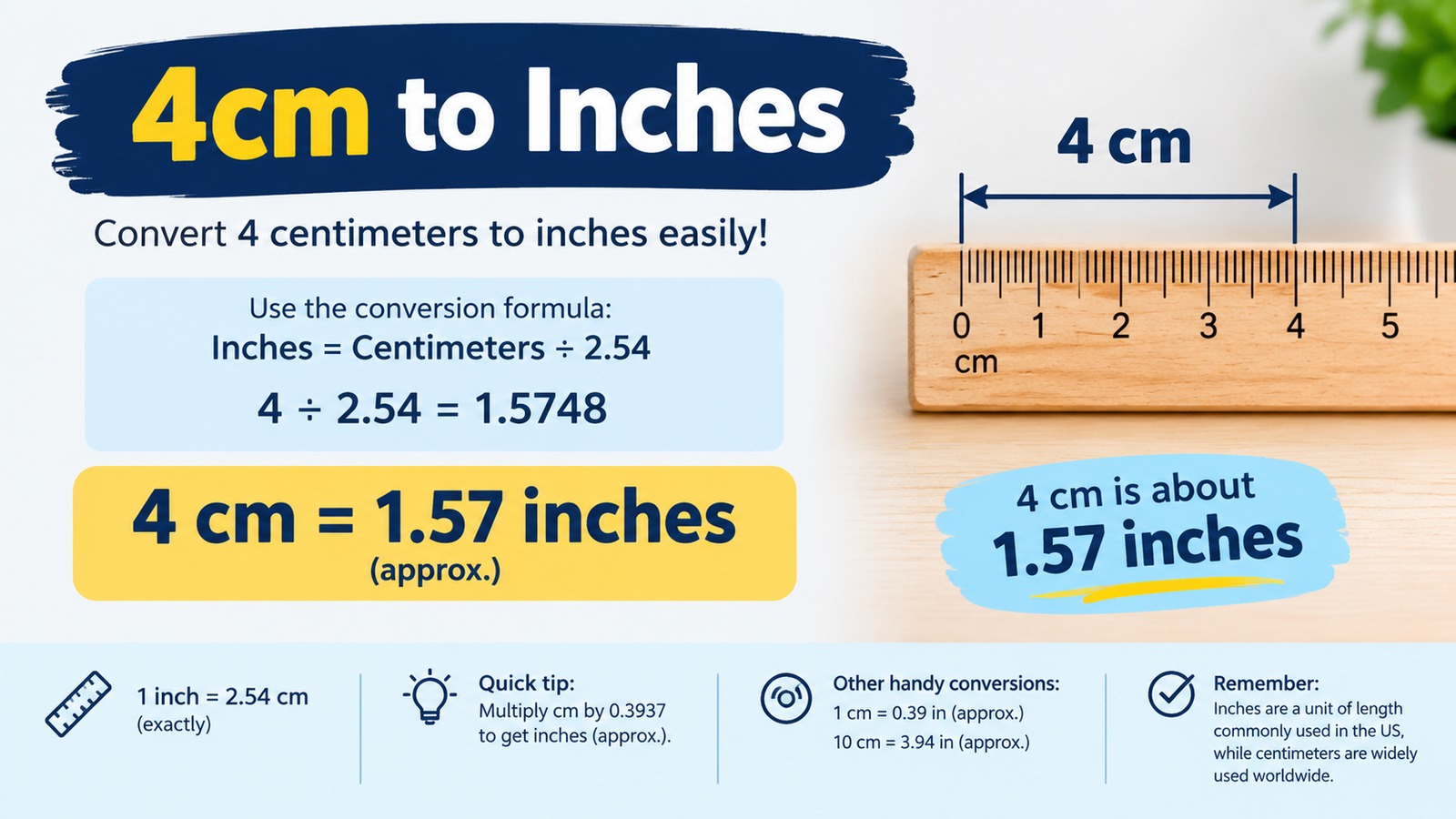
When measuring heights, lengths, widths, clothes, furniture, electronics and many other items that we use every day, it can be beneficial to convert centimeters to inches. To find out what 4 cm would equal in inches, the approximate value is 1.57 inches.
The centimeter and the inch are both widely-used systems of measuring length. While the centimeter is primarily associated with the metric system, the imperial system primarily uses the inch. When you learn to make conversions from one unit to another, you will find it much simpler to comprehend measurements that have been taken using different units around the world.
You will find in this guide, the method for converting 4cm into inches, the appropriate formula to use, the steps involved in determining the final value, and where this length stands in relation to other frequently used lengths. Also included is a conversion table and some real life examples.
4cm to Inches: Quick Answer
4 centimeters converted to inches
1.5748 inches
Centimeters
4 cm
Rounded result
1.57 inches
1 cm = 0.3937007874 inches
Therefore:
4 cm = 1.5748 inches ≈ 1.57 inches
If you only need a quick measurement, you can use 1.57 inches as the rounded conversion.
How Much Is 4cm in Inches?
An approximate measurement of 4 centimeters is about 1.57 inches. Therefore, a length of 4 cm would be slightly greater than one and a half inches.
The exact conversion would be 1.5748031496 in. However, the final answer will vary based upon the number of decimals used to represent the value.
Here are the common ways to express the measurement:
| Measurement format | Result |
| Exact conversion | 1.5748031496 inches |
| Four decimal places | 1.5748 inches |
| Three decimal places | 1.575 inches |
| Two decimal places | 1.57 inches |
| One decimal place | 1.6 inches |
The number of decimals to use in everyday measurements is typically 2. Technical drawings and precise measurements will usually require more decimal places.
How to Convert 4cm to Inches?
Converting centimeters to inches is straightforward as long as you use the correct mathematical equation. One inch is equal to 2.54 centimeters. To find the size in inches from a centimeter measurement, simply divide the number of centimeters by 2.54.
Formula:
Inches=Centimeters2.54
Let’s apply this formula to 4 centimeters.
Step-by-step calculation:
- Start with the measurement: 4 cm.
- Divide the measurement by 2.54.
- Calculate the result.
42.54=1.5748031496
Therefore:
\[ \boxed{4\text{ cm}=1.5748\text{ inches}} \]
You can also use the multiplication method. Multiply 4 by 0.3937007874 to get the same result.
40.3937007874=1.5748031496
Both methods provide the same conversion.
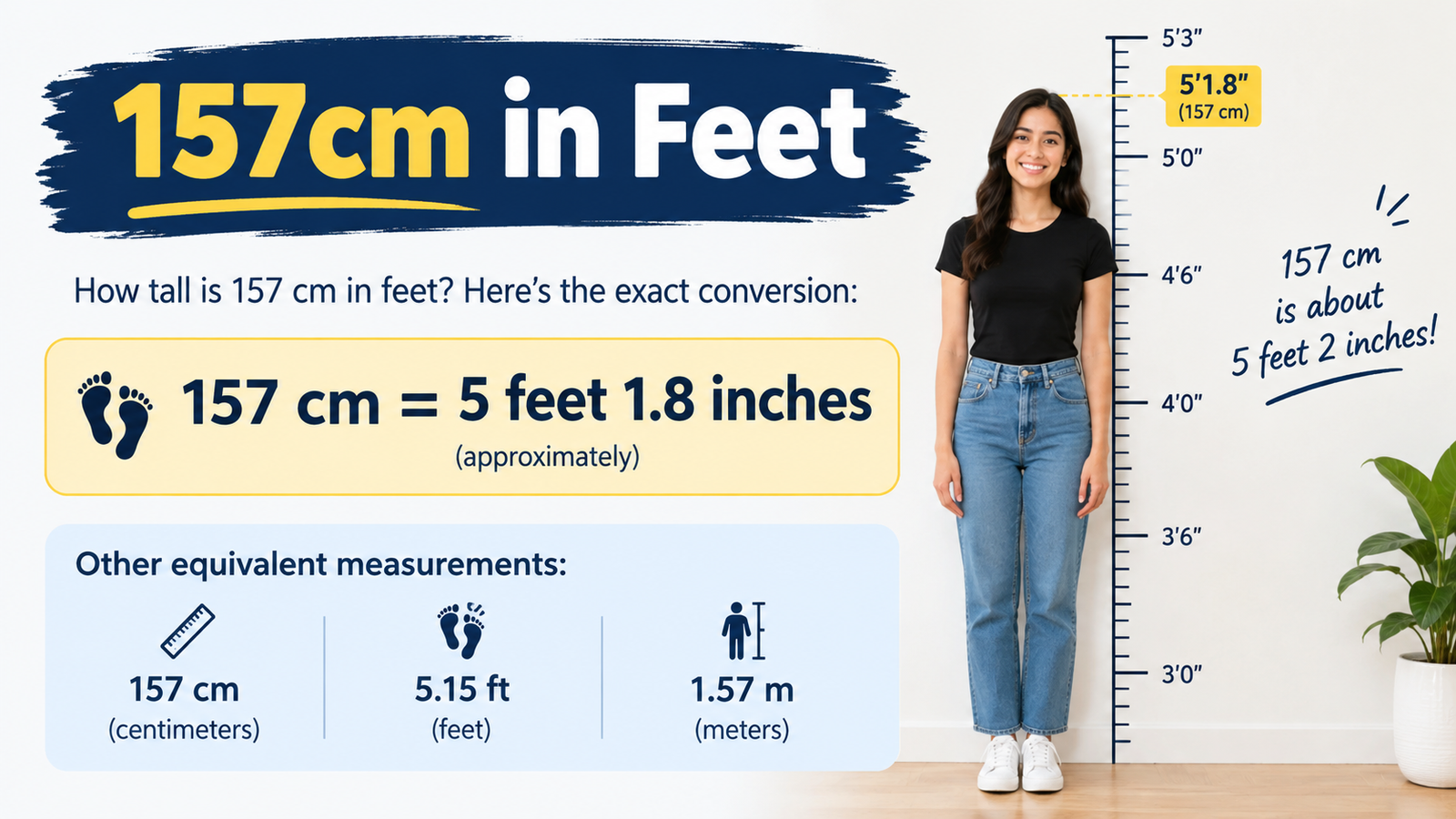
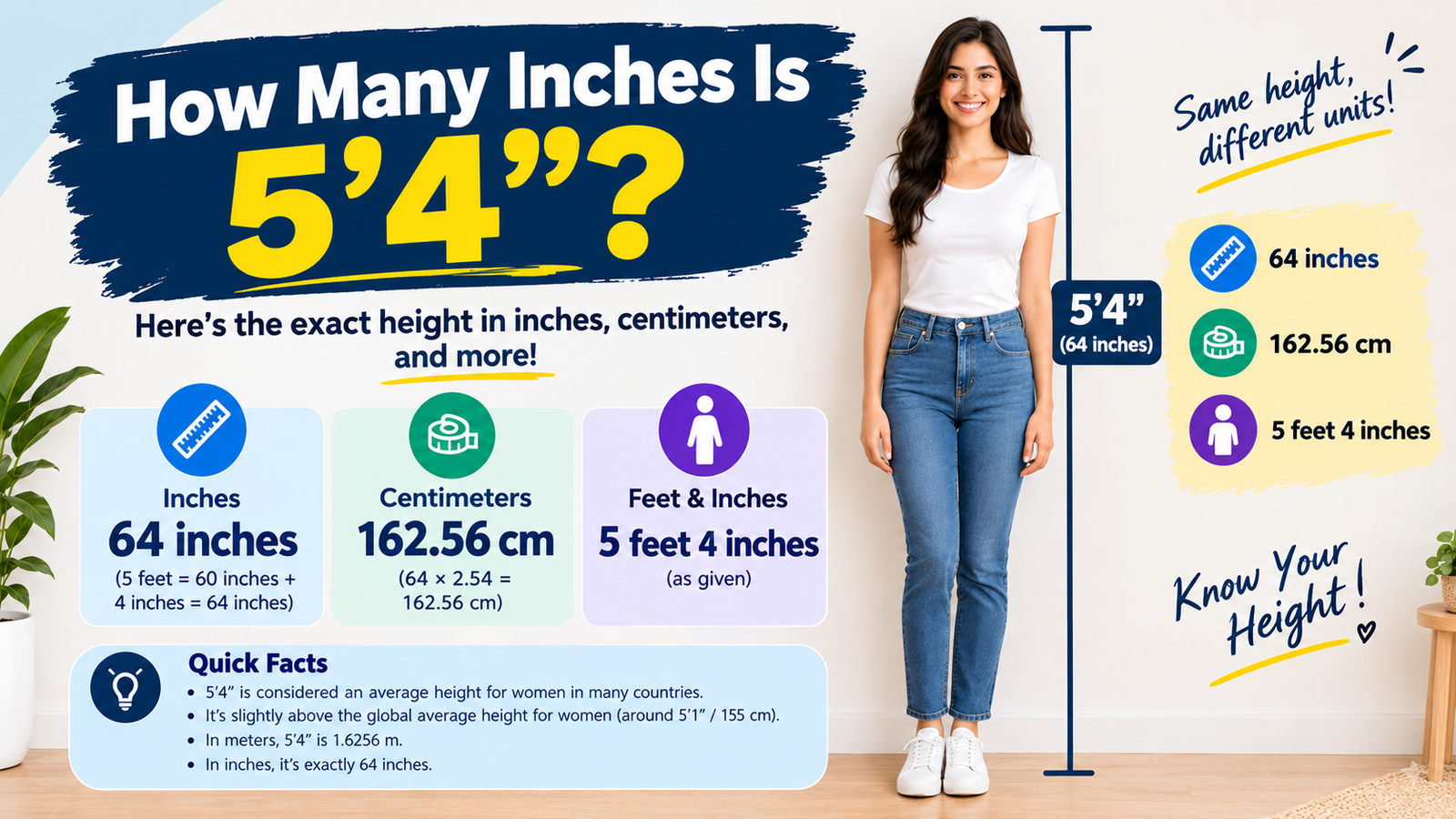
Also Read: 85mm to Inches | 157cm in Feet | How Many Inches Is 5’4″?
Understanding Centimeters and Inches
Centimeters and inches are two methods for measuring length or distance. While they both provide a means of measuring a similar characteristic, the systems that use these measurements differ from one another.
What Is a Centimeter?
A centimeter is a unit of length in the metric system. It is equal to one hundredth of a meter.
The metric system is used globally in many nations such as India, the United Kingdom, Canada and most European countries.
For example:
- 1 centimeter = 10 millimeters.
- 10 centimeters = 100 millimeters.
- 100 centimeters = 1 meter.
- 4 centimeters = 40 millimeters.
Centimeters can be used to describe the dimensions of a variety of things, including small objects, human bodies, stationery and other household goods.
What Is an Inch?
An inch (in) is a unit of length in the Imperial System of Measurement and in the United States Customary System of Measurement.
This unit of measurement is most frequently used in the U.S. when making measurements of screens, furniture, building materials, and self-measurements.
The standard relationship is:
- 1 inch = 2.54 centimeters.
- 1 inch = 25.4 millimeters.
- 12 inches = 1 foot.
- 36 inches = 1 yard.
Since one inch is larger than one centimeter, a measurement that was originally expressed in inches would result in a lower numerical value when expressed in centimeters.
4cm to Inches Conversion Chart
This table compares various centimeter measurements to their equivalent inch measurements. It is designed to assist you in converting measurements quickly and easily by eliminating the need to perform the math every time.
| Centimeters (cm) | Inches (in) |
| 1 cm | 0.39 inches |
| 2 cm | 0.79 inches |
| 3 cm | 1.18 inches |
| 4 cm | 1.57 inches |
| 5 cm | 1.97 inches |
| 6 cm | 2.36 inches |
| 7 cm | 2.76 inches |
| 8 cm | 3.15 inches |
| 9 cm | 3.54 inches |
| 10 cm | 3.94 inches |
| 12 cm | 4.72 inches |
| 15 cm | 5.91 inches |
| 20 cm | 7.87 inches |
| 25 cm | 9.84 inches |
| 30 cm | 11.81 inches |
| 50 cm | 19.69 inches |
| 100 cm | 39.37 inches |
These figures have been rounded off to two decimal places. The conversion rate is based on the standard relationship between centimeters and inches, as specified by the National Institute of Standards and Technology (NIST).
4cm to Inches in Different Units
You will sometimes have to transform 4 cm into different unit lengths than inches. Understanding how to use various units of measurement will be helpful when you are measuring products, crafts, or other small objects.
Here is a quick breakdown:
| Unit | Equivalent of 4 cm |
| Inches | 1.5748 in |
| Millimeters | 40 mm |
| Meters | 0.04 m |
| Feet | 0.1312 ft |
| Yards | 0.0437 yd |
For example, 4 centimeters is equal to 40 millimeters since each centimeter is made up of 10 millimeters. Also, if you were to divide 4 by 100, then your answer would be 0.04 meters.
Where Is a 4cm Measurement Used?
A 4 cm measurement may seem small; however, it has practical applications for many different types of daily tasks. A 4 cm measurement can be used to indicate the size of various types of household items, jewelry and other accessories, craft supplies, and component parts of products.
Some common examples include:
1. Jewelry and Accessories
The measurement of four centimeters is representative of either the width or length of many types of small jewelry, decorative accessory, and fashion products. When you convert this metric value into inches, it provides the shopper with a better understanding of the size of products offered by international shopping sites.
2. Clothing Measurements
Clothing brands frequently use centimeters for measurement. When converting 4 cm to approximately 1.57 inches, it allows customers to make comparisons of the size of specific aspects of a garment (i.e. seams, embellishments, accessories).
3. Home Decoration
Measurements of small decorative items, hardware components and craft materials are sometimes given in centimeters. If you know how many inches each centimeter represents, then you can use that information to make direct comparisons between those measurements and products that use imperial measurement systems.
4. School and Office Projects
Many students and professionals will often convert centimeters into inches, for example, if they are using a ruler which displays both types of measurements (i.e. metric and imperial), while creating diagrams, measuring paper, or developing crafts.
5. Online Shopping
When you are purchasing items from international shopping websites, they will often include the measurements of the product in either cm (centimeters) or inches. Knowing that 4 cm is equal to about 1.57 inches can help to prevent you from being confused as you compare the sizes of products.
How to Convert Centimeters to Inches Without a Calculator
You don’t always need a calculator when you want to change centimeters to inches. You can use a simple multiplication technique to get an idea of what the answer will be.
Remember this conversion factor:
1cm0.3937inches
For a quick mental calculation, you can use 0.39 instead of 0.3937007874.
For 4 centimeters:
40.39=1.56
The estimated result is 1.56 inches and the more precise result is 1.5748 inches.
This shortcut is good enough for most of your everyday measuring needs, as long as you’re not looking for extreme precision. When you need to make sure that what you’re converting is as accurate as possible, then use the full conversion factor.
Common Mistakes When Converting 4cm to Inches
Although converting from centimeters to inches is very simple, some errors may result in incorrect answers.
- In order to convert centimeters into inches, you should divide by 2.54 rather than multiplying by 2.54.
- Using the Incorrect Conversion Factor: Keep in mind that there is an exact relationship between one inch and 2.54 centimeters.
- Rounding too soon: Maintain the exact value of each calculation with all decimal places and round off only the last number.
- Confusing Centimeters and Millimeters: A centimeter is equal to 10 millimeters, not 100 millimeters.
- For most people, a rounded-off value of 1.57 inches would be more than enough to satisfy their needs, however, there are many applications where precision is needed.
Following the correct formula helps you get reliable results.
Conclusion
Using the basic conversion formula to convert 4 cm to inches is very easy. There are about 1.5748 inches in 4 cm (or 1.57 inches after rounding). When converting cm to inches, simply divide the cm measurement by 2.54, or multiply it by 0.3937. These methods will allow you to get precise measurements for shopping, clothes, home improvements, school assignments and other daily activities.
FAQs about 4cm to Inches
1. How many inches is 4cm?
4 centimeters equals 1.5748 inches. Rounded to two decimal places, the result is 1.57 inches.
2. What is the formula to convert 4cm to inches?
Divide the centimeter measurement by 2.54. The formula is Inches = Centimeters ÷ 2.54.
3. Is 4cm bigger than 1 inch?
Yes. Four centimeters equals approximately 1.57 inches, which is bigger than 1 inch.
4. How many millimeters are in 4 centimeters?
There are 40 millimeters in 4 centimeters because 1 centimeter equals 10 millimeters.
5. How do I convert centimeters to inches quickly?
Multiply the centimeter value by 0.3937. For example, 4 × 0.3937 gives approximately 1.5748 inches.
Also Read: 71 Inches in Feet | 220 CM to Feet | Kilometer to Meter Conversion