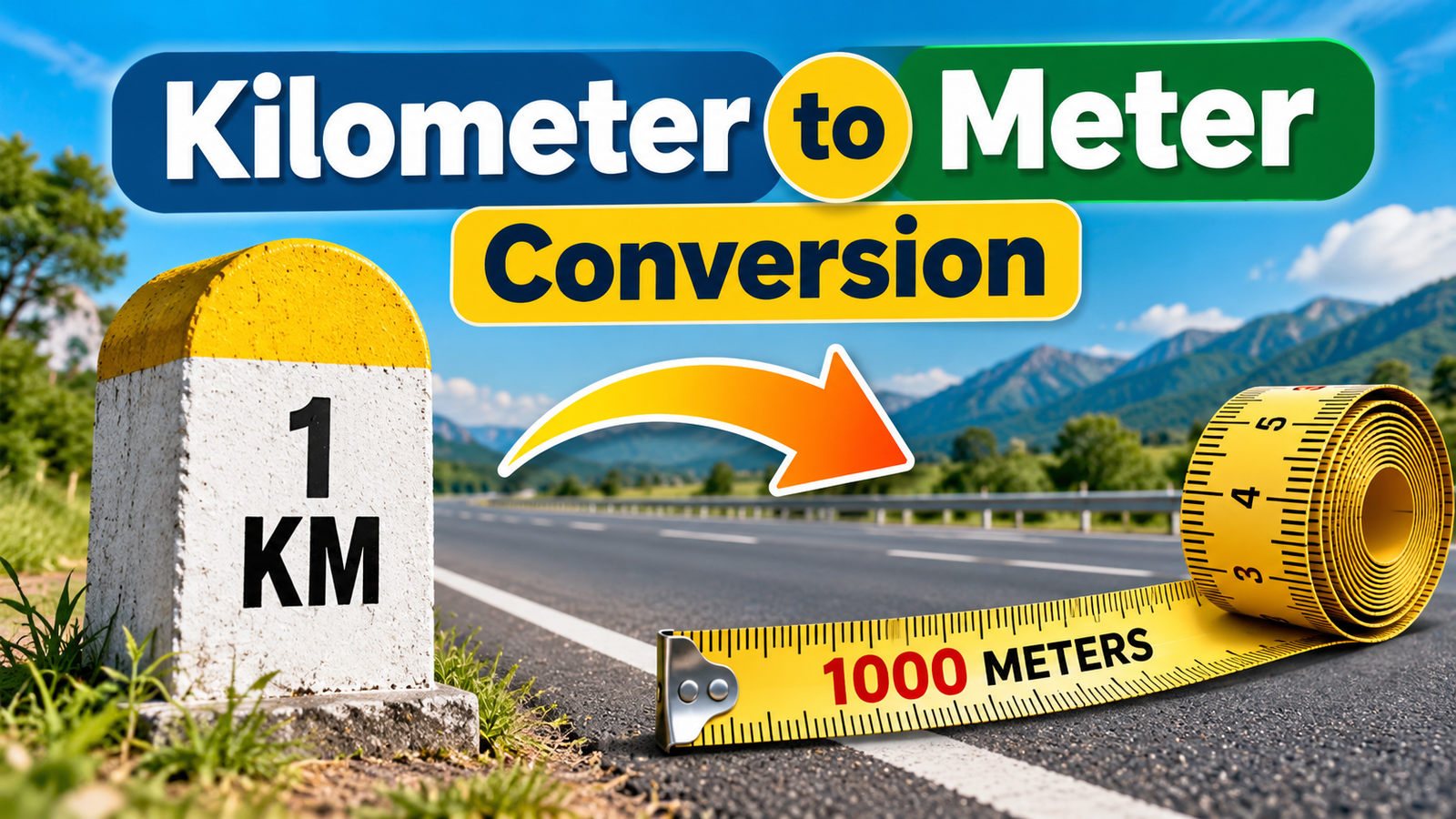
The conversion of kilometers to meters is one of the most frequently used conversions in math, science, engineering, transportation and many other areas of our daily lives. From calculating distances traveled by plane between different cities to measuring a runner’s distance completed during a race to completing a math homework assignment, knowing how to change kilometers to meters will help you in countless situations.
To convert a unit of measurement from kilometers to meters, you can simply use the equation: 1 km = 1000 m. When you are converting a unit of measurement from kilometers to meters, you will need to multiply your kilometer value by 1000.
This article will teach you how to convert kilometers into meters using the formula for converting kilometers into meters, step-by-step mathematical calculations, conversion tables, examples of when to use these formulas in everyday life, statistical data about the topic, and common questions people have regarding this formula.
What Is a Kilometer?
A kilometer is a metric measurement used for large distances. This is part of the International System of Units (SI) as a decimal multiple of the meter. The name kilometer comes from the combination of “kilo,” which means one thousand, and “meter,” which is the base unit of length in the SI.
The kilometer is a standard unit of measurement for determining the distance between two points such as cities, highways, train lines, racecourses, and other geographic features.
An example would be, if you lived 3 kilometers away from your school, then the distance is 3,000 meters.
Important Facts About Kilometers
| Measurement | Value |
| Unit Name | Kilometer |
| Symbol | km |
| Metric Equivalent | 1,000 meters |
| Centimeters | 100,000 cm |
| Millimeters | 1,000,000 mm |
| Miles | Approximately 0.621371 miles |
| Feet | Approximately 3,280.84 feet |
| SI Classification | Decimal multiple of the meter |
What Is a Meter?
The meter (m) is the international system of units (SI) standard for measuring length. This standard is recognized globally and used to determine dimensions such as height, width, length, and distance.
Meter is good for measuring small amounts of distance (e.g., room length, building height, playground size, swimming pool dimensions).
A typical Olympic-sized swimming pool measures 50 meters in length. Twenty lengths of such a pool would be equal to one kilometer.
Important Facts About Meters
| Measurement | Value |
| Unit Name | Meter |
| Symbol | m |
| Kilometer Equivalent | 0.001 km |
| Centimeters | 100 cm |
| Millimeters | 1,000 mm |
| Inches | Approximately 39.37 inches |
| Feet | Approximately 3.28084 feet |
| SI Base Unit | Length |
How Many Meters Are in 1 Kilometer?
The unit of length “kilometer” (km) equals 1,000 “meters” (m). Both km and m are used to determine distance in the metric system. The km is typically used to determine long distances, whereas the m is commonly used to determine short distances, such as the size of a room, playground, or building.
To find out how many meters are in a number of kilometers, just multiply the kilometer value you have by 1,000. So, for example, if the distance between two points was 5 km, then that distance would be the same as 5,000 m.
Kilometer to Meter Conversion Formula
Meters=Kilometers1000
Kilometer to Meter Examples
| Kilometers (km) | Meters (m) |
| 1 km | 1,000 m |
| 2 km | 2,000 m |
| 5 km | 5,000 m |
| 10 km | 10,000 m |
| 25 km | 25,000 m |
| 50 km | 50,000 m |
| 100 km | 100,000 m |
Because the metric system is based on decimals, the conversion will be the same regardless of what type of distance is being measured (i.e. roads, running tracks, etc.) and therefore 1 km will always equal 1,000 meters.
Kilometer to Meter Conversion Formula
Converting a kilometer measurement into a meter measurement is as easy as doing some simple math. A single kilometer equals 1,000 meters. Therefore, if you have a measurement that is in kilometers, you can convert that measurement to meters by multiplying the number of kilometers in your measurement by 1,000.
The standard kilometer to meter conversion formula is:
Meters=Kilometers1000
This formula works for whole numbers, decimal values, and large distances.
Examples of Kilometer to Meter Conversion
Example 1: Convert 5 Kilometers to Meters
To convert 5 kilometers into meters, multiply 5 by 1,000.
Calculation: 5 × 1,000 = 5,000 meters
Answer: 5 km = 5,000 m
Example 2: Convert 12 Kilometers to Meters
The length of a road that is 12 km long will be equal to the product of 12 and 1000.
Calculation: 12 × 1,000 = 12,000 meters
Answer: 12 km = 12,000 m
Example 3: Convert 2.5 Kilometers to Meters
Using the exact same formula you can convert decimal values as well. To do so multiply 2.5 times 1,000.
Calculation: 2.5 × 1,000 = 2,500 meters
Answer: 2.5 km = 2,500 m
Example 4: Convert 0.75 Kilometers to Meters
For distances smaller than one kilometer, multiply the decimal value by 1,000.
Calculation: 0.75 × 1,000 = 750 meters
Answer: 0.75 km = 750 m
Quick Kilometer to Meter Calculation Table
| Distance in Kilometers | Calculation | Distance in Meters |
| 5 km | 5 × 1,000 | 5,000 m |
| 12 km | 12 × 1,000 | 12,000 m |
| 2.5 km | 2.5 × 1,000 | 2,500 m |
| 0.75 km | 0.75 × 1,000 | 750 m |
An easy way to help you remember how to do this conversion is to move the decimal point over three times to the right. Moving the decimal point will allow you to convert from kilometers to meters quickly and easily without having to use a calculator.
Kilometer to Meter Conversion Chart
This kilometer-to-meter conversion chart contains frequently used measurements that are helpful to students, working professionals, and other individuals conducting routine calculations.
| Kilometers (km) | Meters (m) |
| 0.01 km | 10 m |
| 0.05 km | 50 m |
| 0.1 km | 100 m |
| 0.25 km | 250 m |
| 0.5 km | 500 m |
| 0.75 km | 750 m |
| 1 km | 1,000 m |
| 1.5 km | 1,500 m |
| 2 km | 2,000 m |
| 2.5 km | 2,500 m |
| 3 km | 3,000 m |
| 4 km | 4,000 m |
| 5 km | 5,000 m |
| 7.5 km | 7,500 m |
| 10 km | 10,000 m |
| 15 km | 15,000 m |
| 20 km | 20,000 m |
| 25 km | 25,000 m |
| 50 km | 50,000 m |
| 100 km | 100,000 m |
| 500 km | 500,000 m |
| 1,000 km | 1,000,000 m |
Kilometer to Meter Conversion Statistics
Understanding how to relate km to m will help you find the correct distance for your calculations. Both units belong to the Metric System and they can be found in many different fields such as education, sports, transportation, engineering, and scientific measurements.
The following table lists the most critical kilometer to meter conversions as well as real world examples.
| Measurement | Kilometers (km) | Meters (m) | Description |
| 1 Kilometer | 1 km | 1,000 m | Standard conversion |
| 1 Meter | 0.001 km | 1 m | Reverse conversion |
| Half Kilometer | 0.5 km | 500 m | Short distance |
| 5K Running Race | 5 km | 5,000 m | Popular running distance |
| 10K Running Race | 10 km | 10,000 m | Long-distance running event |
| Half Marathon | 21.0975 km | 21,097.5 m | Half-marathon distance |
| Full Marathon | 42.195 km | 42,195 m | Official marathon distance |
| 100 Kilometers | 100 km | 100,000 m | Long-distance measurement |
Important Kilometer to Meter Facts
- The exact conversion used by the metric system is 1 kilometer = 1,000 meters.
- 1 Meter = 0.001 Kilometer: Divide the number of meters by 1,000 to find out how many kilometers there are.
- 5 Kilometers = 5,000 Meters: A typical distance for both leisure and racing.
- 10 kilometers = 10,000 meters; a common distance used in running events and other types of athletic competitions.
- 42.195 Kilometers = 42,195 Meters: The official distance of a full marathon.
These numbers demonstrate how km and m relate to each other. This knowledge allows students, athletes, travelers, and engineers to quickly determine and compare distances without error in measuring.
Difference Between Kilometer and Meter
Both kilometers and meters can be used to describe how far something is. However, each type of measurement has a specific purpose. For example, if you want to know how far it is from your house to school, you will probably use kilometers. If you want to know how wide your bed is, you may want to use meters.
| Basis | Kilometer | Meter |
| Symbol | km | m |
| Measurement Type | Length or distance | Length or distance |
| Metric Value | 1,000 meters | 0.001 kilometer |
| Common Uses | Roads, travel, races | Buildings, rooms, fields |
| Relative Size | Larger unit | Smaller unit |
| SI Status | Multiple of SI base unit | SI base unit |
The BIPM defines the meter as the base unit for measuring length in the SI system, and the prefix kilo represents a multiple of 1000.
How to Convert Meters to Kilometers
At other times, you may find that you need to go backward with your calculations. Rather than converting from km to m, you will be going from m to km.
The formula is:
Kilometers=Meters1000
For example, if a road is 8,500 meters long, divide 8,500 by 1,000.
8,500 ÷ 1,000 = 8.5 kilometers.
The reverse conversion is particularly helpful in interpreting GPS data, road distance, athletic achievement, and geographic data.
Also Read: How Long Is 100 Feet? | How Tall Is 48 Inches in Feet? | How Big is 3 Inches?
Real-Life Applications of Kilometer to Meter Conversion
Kilometer to Meter Conversion is used for many applications in different sectors of industry and daily life.
1. Road Transportation
Engineers can use meters to measure the distance of a road, but they often use kilometers. Engineers may have to change from using kilometers to using meters when they are designing roads, figuring out how much materials they will need, or drawing the plans for the road.
For example, a 12 km road is 12,000 meters long.
2. Sports and Athletics
Kilometers and meters are used to describe the distance for running events. For example, a 5K race is 5,000 meters; a 10K race is 10,000 meters.
An athletic track that is used for competition, which is typically located outside, usually has a length of 400 meters in its first lane. Because of this, it would take two and a half laps to run 1,000 meters, and 25 laps to run 10,000 meters.
3. Construction and Engineering
When engineers plan roads, pipelines, bridges, and railways, they will often need to change units of distance (i.e., kilometers to meters) to make sense of their plans.
For example, a pipeline extending 3.75 kilometers has a length of 3,750 meters.
4. Education and Mathematics
Students are introduced to the concept of metric conversion so that they can develop their understanding of decimal multiplication, measurement systems and how to solve problems mathematically.
These calculations can be helpful for taking basic science exams, competitive exams, and aptitude tests.
5. Navigation and GPS
The majority of navigation systems present larger distances as kilometers and smaller distances as meters.
As an example of this, a navigation application may indicate that the distance to your destination is 2.4 kilometers (or 2,400 meters).
Kilometer to Meter in Sports: Distance Statistics
The following table shows several standard running-event distances and their equivalents.
| Running Event | Kilometers | Meters |
| 100-meter sprint | 0.1 km | 100 m |
| 200-meter sprint | 0.2 km | 200 m |
| 400-meter race | 0.4 km | 400 m |
| 800-meter race | 0.8 km | 800 m |
| 1,500-meter race | 1.5 km | 1,500 m |
| 3,000-meter race | 3 km | 3,000 m |
| 5K race | 5 km | 5,000 m |
| 10K race | 10 km | 10,000 m |
| Half marathon | 21.0975 km | 21,097.5 m |
| Marathon | 42.195 km | 42,195 m |
These numbers show the value of having accurate unit conversion for competing in sports, planning races, and tracking your physical activity.
Easy Tricks to Convert Kilometers to Meters
One of the simplest methods of changing kilometers into meters is moving the decimal point three positions to the right.
For example:
- 3 km becomes 3,000 m.
- 4.5 km becomes 4,500 m.
- 0.8 km becomes 800 m.
- 0.025 km becomes 25 m.
The reason this method works is that when you multiply a number by 1,000, you are essentially moving its decimal point over three places to the right.
The next tip for memorizing the metric system is to learn its common prefixes. A “kilo” indicates 1,000 units, a “centi” is 1/100th of a unit, and a “milli” is 1/1,000th of a unit. All three of these standard metric prefixes are helpful in converting between different types of measurements.
Common Mistakes When Converting Kilometers to Meters
Students occasionally convert metric units incorrectly. The most frequent mistake made is that they multiply the number of units by 100 rather than 1,000.
Another error is shifting the decimal point in the opposite direction. To convert from kilometers to meters, the resulting value will be bigger since meters represent a smaller unit of measure.
It is equally vital to differentiate between kilometers and kilometers per hour. Kilometers are used to quantify distance, whereas kilometers per hour are utilized to quantify speed. As a result of this difference, these two units cannot be used interchangeably.
The proper use of symbols will also be an important part of your work. The correct abbreviation for “kilometer” is “km,” and the correct abbreviation for “meter” is “m.” The National Institute of Standards and Technology (NIST) suggests that you include a space between the number and the unit symbol, for example, 5 km or 500 m.
Practice Questions for Kilometer to Meter Conversion
Try solving these examples to improve your understanding.
| Question | Calculation | Answer |
| Convert 6 km to m | 6 × 1,000 | 6,000 m |
| Convert 8.2 km to m | 8.2 × 1,000 | 8,200 m |
| Convert 0.35 km to m | 0.35 × 1,000 | 350 m |
| Convert 14.75 km to m | 14.75 × 1,000 | 14,750 m |
| Convert 125 km to m | 125 × 1,000 | 125,000 m |
Conclusion
The process of understanding how to convert from kilometers to meters is a fundamental math skill that has many different applications in education, transportation, sports, engineering, and everyday life. With one kilometer equal to precisely 1,000 meters, converting between these two units is as simple as either multiplying or dividing.
By memorizing the conversion formula, referencing a table, and working through problems with decimals, you will be able to perform quick conversions of distance measurements without the use of a calculator.
The most important relationship to remember is 1 km = 1,000 m. Therefore, it will be easy to convert any number of kilometers into meters.
FAQs About Kilometer to Meter
1. How many meters are in 1 kilometer?
The number of meters per kilometer is precisely 1,000. To convert a kilometer value into meters, multiply the kilometer value by 1,000.
2. How do you convert km to m?
Multiply the distance in kilometers by 1,000. For example, 7 km × 1,000 = 7,000 meters.
3. How many meters are in 0.5 kilometers?
There are 500 meters in 0.5 kilometers.
4. Is 1 kilometer equal to 100 meters?
No. One kilometer equals 1,000 meters, while 100 meters equals 0.1 kilometers.
5. How many meters are in 2.5 km?
There are 2,500 meters in 2.5 kilometers.
Also Read: 85mm to Inches | 157cm in Feet | How Many Inches Is 5’4″?